We’re diving deep into the dimensions of the Leadership Circle Profile—one at a time—to surface insights, get curious, and explore how each dimension helps leaders move from Reactive to Creative leadership. In this post, we’re unpacking Critical—the sharp, discerning edge that can drive excellence and accountability when balanced, or tip into judgment and rigidity when overplayed.
You know that moment when your brain locks onto what’s wrong before you even realize it? The typo in the report. The missed detail in the plan. The way someone said something that could’ve been clearer. Some of us are wired that way—sharp, fast, always scanning for what’s off.
There’s something powerful about having an eye for what’s not working. It can drive excellence. It can keep standards high. It can protect the team from avoidable mistakes. But when that same discernment turns inward or outward as judgment—when it comes without care, without connection, without curiosity—it stops being helpful.
In other words, things stop building and start breaking.
The saying goes that there’s a fine line between a scalpel and a sword. Both are sharp. Both cut. But one heals while the other harms.
The Critical dimension of the Leadership Circle Profile sits right on that razor’s edge.
What Do We Mean by Critical?
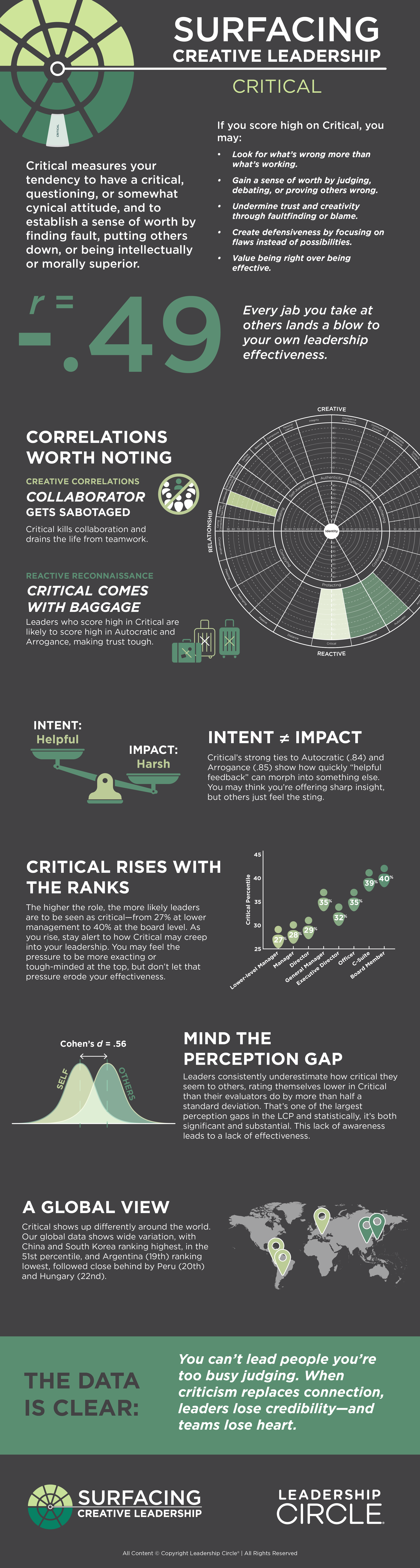
The Critical dimension measures a leader’s tendency to take a fault-finding, questioning, or even cynical stance toward others, situations, or themselves. It’s the habit of establishing a sense of worth by spotting what’s wrong, proving others wrong, or standing just a little taller through continual judgment.
When this energy runs high, it often sounds like “I’m right and you’re not.” It shows up as being rigid, mistrustful, or overly focused on problems instead of solutions. Leaders high in Critical can become known for their sharp eye—but also for their sharp edge. They may appear argumentative, quick to blame, or hard to please.

The irony is that Critical often hides behind rationality. It can sound logical, intelligent, and well-reasoned—especially in cultures or organizations that reward being the smartest person in the room. But underneath that logic is a deep need to prove worth and to feel safe through superiority. That’s what makes Critical so corrosive. It defends a point of view rather than solves a problem.
The data backs this up. Critical is negatively correlated with leadership effectiveness (r = -.49). Highly critical leaders tend to lose credibility and trust within their teams. And to make matters worse, leaders who score high in Critical are also likely to score high in Autocratic and Arrogance. It’s a double whammy: Even when their feedback is intended to be helpful or constructive, it’s often perceived as being negative or harsh.
Leaders who score low on Critical, on the other hand, are often able to lead from an internal sense of worth. Their confidence doesn’t depend on comparison. They can question without condemning and evaluate without diminishing. That absence of judgment clears the path for full creative expression and authentic leadership.
🎥 Dive into the data through Data Wizardry with Joseph Leman.
Why This Dimension Matters
Criticism—especially when it’s sharp, public, or relentless—creates a culture of fear, silence, and defensiveness. It attacks identity and self-worth, making feedback feel personal and punishing. People start editing themselves. They stop offering ideas. They play small to stay safe.
In our recent conversation with Bob Anderson and Bill Adams, co-founders of Leadership Circle, they described it this way: “Are you leveling me or leveling with me?” When feedback becomes a weapon instead of a gift, people stop trusting your aim.
The good news is that the opposite is also true. When a leader learns to harness their discernment with heart—to bring clear vision and authentic compassion—their words land differently. Instead of shutting people down, they lift them up. Instead of breaking trust, they build it.
“If you look at the profile,” said Bob, “Critical is directly across from Courageous Authenticity and Integrity, which are its gifts. It’s willing to tell the truth. It’s courageous in that way—except courage is up top, dead center. It’s the balance between the yin and the yang between heart and power. How do I step into my power? Tell the truth with heart.”
🎥 Watch the full conversation with Bill and Bob.
What It’s Not: Common Misconceptions
Critical is not the same as having high standards. It’s not the same as being analytical, detail-oriented, or someone who simply expects excellence. Those qualities, when rooted in curiosity and care, are powerful.
The Critical dimension becomes problematic when clarity becomes superiority—when the impulse to improve something morphs into a need to prove something. It’s the difference between wanting the best for people and wanting to be seen as the best among them.
This is a fine line to walk, especially for leaders who are wired for achievement and precision. In many organizations, sharp analysis, quick judgment, and visible intellect are rewarded—as they should be. The problem is that over time, those same strengths can harden into habits of cynicism and fault-finding. When every idea is picked apart and every person second-guessed, creativity shrinks.
So, let’s be clear: Discernment is not the enemy of Critical—it’s the evolved form of it.
Reactive Critical says: “I’m right; you’re wrong.”
Creative discernment says: “Something’s off—let’s explore it together.”
One demands perfection; the other seeks truth. One creates defensiveness; the other invites dialogue.
In short, critical is focused internally. Discernment is focused externally.
From Reactive to Creative: The Role of Critical
In our conversation, Bill shared that “For a long time, I believed my value as a leader came from my ability to see what was wrong and say it fast.” That’s the heart of Reactive Critical energy—the belief that being sharp, quick, and right equals being effective.
🎥 Watch the full conversation with Bill and Bob.
But in practice, that sharpness often cuts more than it clarifies. People brace for impact instead of leaning in. The leader’s words may be accurate, but they stop being helpful the moment they stop being human.
The goal isn’t to stop having high standards, to stop being analytical or detail-oriented, or to stop expecting excellence. It’s to bring those qualities through with an open, undefended heart. When clarity and compassion travel together, feedback becomes fuel for learning, not fear.
Creative leaders still name what’s true. They still challenge assumptions and hold high expectations. But they do it in a way that strengthens rather than shames, that builds trust instead of breaking it. They hold people capable, not guilty.
That’s the real transformation—from criticism to connection, from fear to trust, from defending your worth to deepening your impact.
Leveraging Critical: Practices + Prompts
The gift of Critical is clarity. The work is to bring that clarity through care. When we learn to notice what’s not working without judgment—and to name it in service of growth—we turn a Reactive edge into a Creative strength. This isn’t about softening your expectations, it’s about softening your delivery. Speaking truth with heart, sharing insight with empathy, and voicing challenge with respect.
Here are a few ways to practice:
- Pause before pointing. When you notice something “off,” take a breath. Ask: What’s my intent right now—to correct or to connect?
- Deliver feedback as a gift, not a weapon. Frame your observation in service of the other person’s growth, not your own need to be right.
- Balance the lens. For every flaw you see, name a strength. Train your perception to see what’s working as vividly as what’s not.
- Watch your inner critic. The same voice that judges others often judges you. Practice self-compassion to loosen its grip.
- Model undefendedness. Admit when you’re wrong, or when you’ve been harsh. That humility invites trust.
Prompts for reflection:
- When does my Critical energy show up most strongly?
- What am I defending when I become judgmental?
- How might I turn my sharpness into a source of clarity and care?
Curious how this dimension shows up in leadership and coaching moments?
🎥 In a recent webinar, Leadership Circle coaches Brett Wood and Peter Shields explored how Critical shapes leaders’ everyday choices—and how leaders can harness the energy of critique so that it builds up rather than tears down.
Recommended Reading
Want to explore more about transforming sharp insight into meaningful connection? These books offer practical wisdom for giving feedback with clarity, care, and courage.
- Crucial Conversations: Tools for Talking When Stakes Are High by Joseph Grenny, Kerry Patterson, et al.
A modern classic on how to stay calm, clear, and connected in high-stakes moments, teaching you to replace defensiveness with dialogue and turn difficult conversations into breakthroughs. - Dare to Lead: Brave Work. Tough Conversations. Whole Hearts by Brené Brown
Through powerful stories and research on vulnerability and courage, Brown shows how brave leaders create trust by leading with heart, not armor. - The 15 Commitments of Conscious Leadership: A New Paradigm for Sustainable Success by Jim Dethmer, Diana Chapman, et al.
A practical guide to leading from presence rather than reactivity, offering tools and practices that shift teams and leaders from blame and fear to curiosity and co-creation. - Self-Compassion: The Power of Being Kind to Yourself by Kristin Neff
Based on years of concrete research and neurological studies, Neff offers a compelling and proven way to develop the skill of self-compassion without feeling like you’re constantly letting yourself off the hook.
Final Thoughts: Sharp Mind, Open Heart
Being critical isn’t the problem. It’s the energy behind that criticism that is the key.
At its best, Critical helps us see clearly. It’s the part of us that notices patterns, inconsistencies, and opportunities to improve. But when that gift is weaponized, it breaks connection and trust—the very things leadership depends on.
The invitation is simple but not easy: Be clear, direct, and loving—all at once. That’s what undefended leadership looks like.
And when we lead that way, people don’t brace for our feedback. They look forward to it.





I love how this post highlights the importance of self-awareness in leadership. Recognizing when our drive for excellence veers into judgment can be a game-changer in creating a more collaborative, creative environment. Curious if there are any practices that can help leaders catch themselves before falling into that trap?
This is a great breakdown of the ‘Critical’ dimension. I’ve definitely seen leaders, and been that leader myself at times, who fall into the ‘sword’ category. Recognizing the difference and consciously shifting towards the ‘scalpel’ – focusing on constructive feedback instead of just finding fault – is crucial for building a positive and productive team environment. Thanks for highlighting this important nuance!
Short but powerful — great advice presented clearly.
Great job! The conclusion tied everything together nicely.
Your blog is a testament to your passion for your subject matter. Your enthusiasm is infectious, and it’s clear that you put your heart and soul into every post. Keep up the fantastic work!
I appreciate the step-by-step instructions. They made implementation easy.
This was beautiful Admin. Thank you for your reflections.
This article brilliantly skewers the smartest person in the room syndrome! Its hilarious how it exposes the difference between sharp analysis and just being a Reactive Critical know-it-all. Calling out flaws without judgment? Thats the leadership equivalent of telling everyone their outfits ugly without offering fabric suggestions. The key takeaway, though slightly terrifying, is brilliant: channel that critical energy through compassion. It’s like teaching your inner cynic to moonwalk instead of stomp. Now, I’m off to practice pausing before pointing out my boss’s coffee cup placement… with heart!
This article really hits home! I’ve definitely seen both sides of “Critical” in leaders. That sharp eye can be invaluable, but it’s so easy to cross the line into negativity. The key is awareness and intentionality – knowing when to use the scalpel for healing and avoiding the sword that harms. Great food for thought!
Really insightful post — Your article is very clearly written, i enjoyed reading it, can i ask you a question? you can also checkout this newbies in classied. iswap24.com. thank you
Really insightful post — Your article is very clearly written, i enjoyed reading it, can i ask you a question? you can also checkout this newbies in classied. iswap24.com. thank you
Really insightful post — Your article is very clearly written, i enjoyed reading it, can i ask you a question? you can also checkout this newbies in classied. iswap24.com. thank you