

We’re diving deep into the dimensions of the Leadership Circle Profile—one at a time—to surface insights, get curious, and explore how each dimension helps leaders move from Reactive to Creative leadership. In this post, we’re unpacking Caring Connection—the Creative leadership capacity that quietly but profoundly shapes trust, engagement, and collective effectiveness.
“It’s not personal, it’s business.”
We’ve heard some version of that line so often it’s become leadership gospel—as if care somehow contaminates credibility, or professionalism requires distance. And yet our lived experience tells a very different story.
Think of a leader who changed the way you saw yourself.
Not because they had all the answers. Not because they set the boldest strategy or drove the hardest results. But because, in a moment that mattered, you felt genuinely seen.
Maybe it was the pause they took before responding. The question they asked that went just beneath the surface. Or the way they held space when things were messy, emotional, or unresolved.
Those moments stay with us because they awaken something deeply human—and deeply powerful. They remind us that leadership is sometimes about direction and performance; but mostly, it’s about relationship. About connection. About care. The leaders who most shape us understand a quiet truth the quote gets wrong: leadership is personal—because people are personal.
This is where the dimension of Caring Connection comes in. Caring Connection is the capacity to form warm, genuine relationships with others—to prioritize the human side of leadership. It is the ability to stay present and engaged, to know people as people, and to build trust that goes beyond transactions. Far from weakening leadership, Caring Connection strengthens it, creating the relational foundation on which courage, candor, and performance can thrive.
What Do We Mean by Caring Connection?
Caring Connection is the humanity in our leadership.
It is the capacity to relate to others with genuine warmth, empathy, and respect—to see people not as roles, resources, or means to an end, but as whole human beings. On the Leadership Circle Profile (LCP), Caring Connection reflects how consistently a leader brings presence, care, and relational attunement into everyday interactions.
Leaders who score high in Caring Connection understand that leadership does not happen to people; it happens with them. They value relationships not as an added benefit of working together, but as a core driver of trust, engagement, and sustainable results. Their leadership feels personal—because it is.
These leaders are often experienced as warm, attentive, and authentic. They listen deeply and are curious about others’ perspectives. They notice emotional undercurrents and respond with sensitivity and respect. Over time, they create environments where people feel safe to contribute fully, speak candidly, and bring their best thinking forward.
Leaders strong in Caring Connection tend to:
- Demonstrate empathy without losing clarity or accountability
- Build trust through consistency, presence, and follow-through
- Balance candor with compassion
- Foster inclusion, belonging, and mutual respect
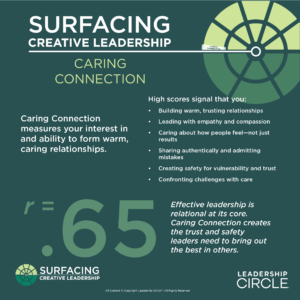
Importantly, Caring Connection has a strong relationship to overall leadership effectiveness—a statistical correlation r = .65. While that isn’t the largest correlation to leadership effectiveness in the database (that honor goes to Purposeful and Visionary) the correlation here is still significant. But like all leadership competencies in the profile, Caring Connection thrives when leaders know when and how to deploy their abilities. Additionally, without Caring Connection, a leader can fall into Reactive Tendencies that can have a truly negative effect not just on the individual relationship between leader and employee, but on the team as a whole.
The data backs this up. Across tens of thousands of leaders globally, those who lead with greater Caring Connection are consistently rated as more effective by their managers, peers, and direct reports. When leaders strengthen this capacity, people feel more valued and engaged, communication improves, and collaboration becomes easier, creating the conditions for both healthy people and healthy results.
When people feel cared for and connected to, collaboration improves, engagement rises, and performance follows.
🎥 Dive into the data through Data Wizardry with Joseph Leman.
Why This Dimension Matters
Leadership lives in the relational field—the invisible space between people where trust is built, meaning is made, and work actually gets done. Caring Connection directly shapes the quality of that space.
When leaders lead with Caring Connection, individuals experience more than support; they experience dignity. They are more willing to take risks, voice concerns, and stretch beyond what feels safe. Over time, this creates psychological safety—not as a program or initiative, but as a lived experience.
At the team level, Caring Connection becomes the lubricant for honest dialogue and healthy conflict. Teams are better able to navigate tension without fracturing relationships. Feedback flows more freely. Differences are explored rather than avoided. The result is not harmony for its own sake, but stronger thinking and more resilient collaboration.
At the organizational level, Caring Connection plays a critical—often underappreciated—role in culture. In its presence, cultures tend to learn faster, adapt more readily, and retain talent more effectively. In its absence, even highly capable organizations can drift toward fear-based compliance, disengagement, or quiet erosion of trust.
This dimension matters especially under pressure. During periods of change, uncertainty, or stress, people are scanning leaders for cues: Am I seen? Do I matter? Is it safe to be honest here? Caring Connection helps leaders answer those questions—not through reassurance alone, but through consistent, human-centered behavior.
In their recent conversation about Caring Connection, Leadership Circle Chief Knowledge Officer Bob Anderson and co-CEO Bill Adams recount a series of hard conversations they had while negotiating the terms of becoming business partners. “As soon as Caring Connection and love for each other became the field of the interaction,” Bob says, “we broke through quickly on the other issues.” This is how genuine care operates under real pressure—not as a soft skill or worse, a weakness, but as a turning point when the stakes are high.
🎥 Watch the full conversation with Bill and Bob.
In short, Caring Connection is not ancillary to leadership effectiveness—it is foundational. It determines whether strategy lands, whether values are lived, and whether people bring not just their skills, but their hearts and minds to the work.
What It’s Not: Common Misconceptions
Because Caring Connection centers relationships and emotion, it is often misunderstood—and underestimated.
First, Caring Connection is not about being nice at the expense of being effective. It does not mean avoiding hard conversations, lowering standards, or prioritizing comfort over results. In fact, leaders high in Caring Connection are often better at addressing difficult issues precisely because trust already exists. Candor lands differently when people know it is coming from a place of genuine care.
Second, Caring Connection is not about over-accommodating or rescuing others. It is not about carrying emotional weight that does not belong to you, nor is it about putting everyone’s needs ahead of the organization’s purpose. True Caring Connection respects both people and purpose—and holds them together rather than trading one for the other.
Third, Caring Connection is not about being liked. Seeking approval can dilute leadership presence and clarity. Caring Connection is rooted in respect, not popularity. It asks leaders to stay connected even when they must disappoint, challenge, or say no.
Finally, Caring Connection is not a personality trait reserved for naturally warm or extroverted leaders. It is a capacity—a way of relating—that can be practiced and developed. Introverts and extroverts alike can lead with deep care; the expression may differ, but the impact can be just as powerful.
When these misconceptions fall away, Caring Connection reveals itself for what it truly is: a disciplined, intentional practice of human-centered leadership—one that strengthens both relationships and results.
From Reactive to Creative: The Role of Caring Connection
From the Reactive mindset, Caring Connection is often the first thing to disappear.
Under pressure, leaders may become guarded, controlling, or emotionally distant—driven by subconscious beliefs such as: I have to stay in charge, I can’t show vulnerability, or If I don’t assert authority now, I’ll lose credibility. In these moments, connection can feel risky, inefficient, or even unsafe.
From the Creative mindset, Caring Connection becomes a powerful stabilizing force.
Rather than leading through defense or control, Creative leaders stay present. They prioritize curiosity over certainty, relationship over dominance, and truth over self-protection. Caring Connection allows them to engage difficult conversations without collapsing or hardening—to remain open even when emotions run high.
This was powerfully illustrated in Bill and Bob’s conversation about Caring Connection. Bob talks about a moment debriefing an angry physician—someone openly aggressive, frustrated, and pushing hard. Instead of matching the intensity or asserting authority, Bob stayed present and undefended. He chose connection over control. Only after a sense of safety was established did the deeper truth of the situation begin to emerge. The moment marked a clear shift: from fear to curiosity, from defense to presence, from power-over to what Bob often describes as truth with heart. It reinforced a core insight of Caring Connection: you can only say hard things once people feel genuinely cared for. Without connection, truth is resisted. With it, truth becomes possible.
🎥 Watch the full conversation with Bill and Bob.
In this way, Caring Connection supports the movement from Reactive to Creative leadership—not by avoiding tension, but by transforming how leaders relate to it. When leaders operate from care rather than fear, they create the conditions for honest dialogue, shared understanding, and breakthrough—especially in those moments where work becomes overwhelming or difficult.
Leveraging Caring Connection: Practices + Prompts
Fortunately, Caring Connection is not something leaders either have or don’t have—it is something that can be intentionally practiced and strengthened over time. Often, the smallest shifts in presence, attention, and mindset can have an outsized impact on how leadership is experienced.
Below are practical ways leaders can cultivate Caring Connection in everyday moments, followed by prompts that support deeper reflection and ongoing development.
Ways to practice Caring Connection:
- Listen for what matters. Go beyond content to notice tone, emotion, and energy.
- Name what you observe. Reflecting back what you see or hear helps others feel understood.
- Slow the moment. Pause before responding, especially in charged situations.
- Demonstrate consistency. Care builds trust when it shows up reliably, not selectively.
- Hold compassion and accountability together. One does not diminish the other.
Prompts for reflection:
- Where do I show up as most present and connected—and where do I pull away?
- What beliefs do I hold about care and effectiveness?
- How do others experience me in moments of stress or conflict?
- What might become possible if I stayed connected even when outcomes are uncertain?
Curious how this dimension shows up in leadership and coaching moments?
🎥 In a recent webinar, Leadership Circle coaches Tyson Andrus and Patty Oji explored how Caring Connection shapes leaders’ everyday choices—helping them build trust, create psychological safety, and strengthen relationships in ways that lift performance and deepen engagement.
Recommended Reading
Want to explore more about brave, grounded truth-telling in leadership? For those interested in going deeper, these resources offer powerful perspectives related to Caring Connection:
- Compassionate Leadership by Rasmus Hougaard and Jacqueline Carter
A compelling looks at how leaders can hold compassion and effectiveness together—making difficult decisions in ways that strengthen people and results. - Thanks for the Feedback: The Science and Art of Receiving Feedback Well by Douglas Stone and Sheila Heen
This guide shifts the focus from giving better feedback to becoming a better receiver, offering practical insight into how leaders can turn feedback into learning instead of threat. - Brené Brown’s TED Talk: The Power of Vulnerability
Final Thoughts: It Is Personal, Actually
Caring Connection reminds us that leadership is, at its core, a human endeavor.
When leaders lead with presence, empathy, and respect, they unlock more than engagement—they unlock possibility. Teams become braver. Conversations become richer. Results become more sustainable. People are more willing to take risks, tell the truth, and stay invested when things get hard.
The familiar refrain that leadership should never be personal may sound professional, but it overlooks a deeper truth: work is done by people, and people are personal. What we say, how we listen, and whether we stay present—especially under pressure—shapes how leadership is experienced.
In a time when speed and certainty are often prized, Caring Connection invites a different kind of strength: the courage to stay connected, to make leadership human, and to remember that when people feel cared for, they bring more of who they are—and more of what’s possible—to the work.