We’re diving deep into the dimensions of the Leadership Circle Profile®—one at a time—to surface insights, get curious, and explore how each dimension helps leaders move from Reactive to Creative leadership. In this post, we’re unpacking Conservative—the quiet instinct to play it safe that can either steady your leadership or stall your growth.
Some tensions in leadership aren’t meant to be resolved—they’re meant to be held. One of the most vital is the push and pull between vision and caution, innovation and stability. Between forging ahead and honoring what’s already working.
That tension sits at the heart of the Conservative dimension in the Leadership Circle Profile.
Directly opposite Purposeful and Visionary, Conservative reflects the instinct to protect, preserve, and play it safe. It’s often misunderstood—but when leveraged well, it serves as a steadying force that keeps leaders grounded in complex, high-stakes environments.
And like all Reactive Tendencies, its impact depends on what’s driving it: fear or intention. Understanding that distinction can be the difference between getting stuck—and moving forward wisely.
What Do We Mean by Conservative?
In the LCP, Conservative reflects the degree to which a leader operates from a structure of caution, rule-following, and a desire to minimize risk. It’s a stabilizing force. A protective mechanism. It’s the voice in the room that says, “Let’s not throw the baby out with the bathwater.”
Sometimes, it’s exactly what’s needed.
But like all Reactive patterns, Conservative has its gifts and its grip. When driven by fear rather than intention, it can quietly stall progress, suppress innovation, and shrink a leader’s sense of agency.
You’ll see it in leaders who:
- Stick closely to precedent (“We’ve always done it this way.”)
- Avoid visibility or controversy
- Motivate by urging conformity to procedures or standards, and reward subordinates on a similar basis
- Emphasize policies and process over experimentation

Leadership Circle Co-Founder and Chief Knowledge Officer Bob Anderson describes Conservative as the instinct to “champion the tradition,” to bring the best of the past into the future. And that’s a gift—especially in complex systems where safety is non-negotiable. Think of it as the immune system of a business.
But just like your immune system, Conservative can overreact. And when it does, it stops being protective and starts being restrictive.
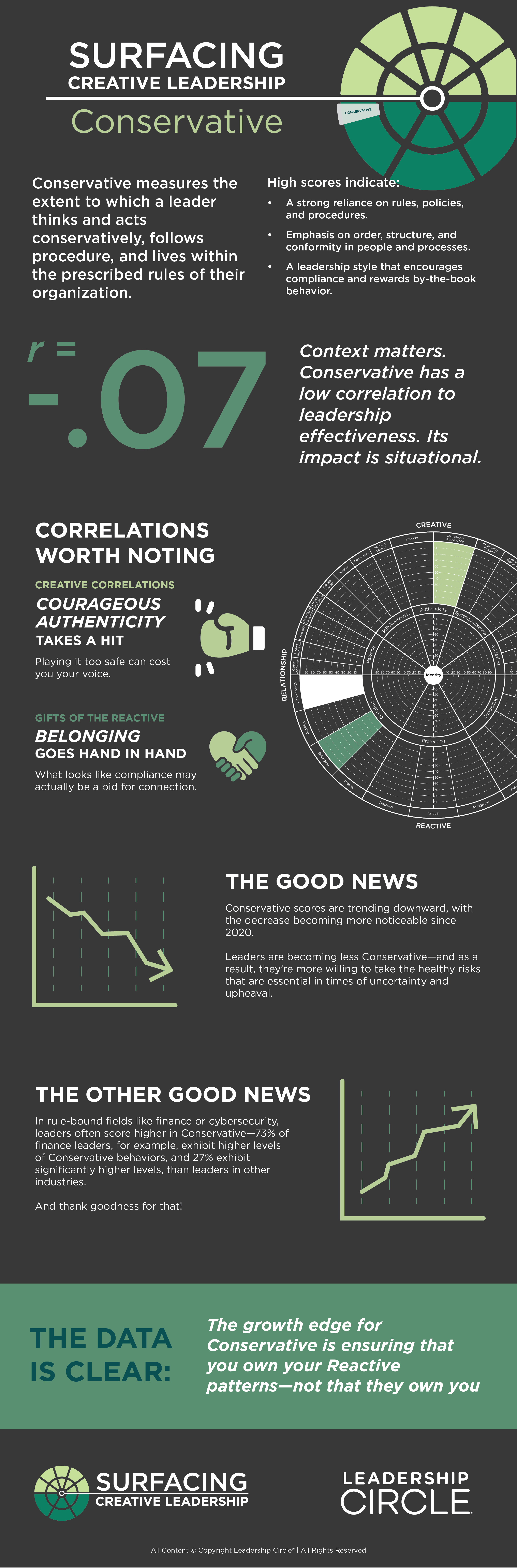
The data backs this up. Conservative has the lowest correlation to leadership effectiveness across the LCP dimensions—not because it’s inherently bad, but because it often correlates with a desire to do what we know works. And to keep doing it. Whether this is an asset or a liability often depends on whether you’re a leader at a nuclear power facility or one in a marketing agency. Context matters.
Why This Dimension Matters
At first glance, Conservative may not seem as flashy as vision, innovation, or transformation. It doesn’t typically show up in bold declarations or sweeping change initiatives. But make no mistake—this dimension shapes the very foundation of how leaders lead.

When overactive, Conservative can quietly constrain a leader’s range. It narrows the field of vision to what’s familiar and safe, often stalling necessary movement before it begins. An overly conservative leader might delay decisions, avoid calculated risks, or struggle to imagine a future beyond what’s already been proven.
But when used well? Conservative can be a stabilizing force amid chaos. It protects the integrity of what works. It preserves safety in high-risk environments. It gives leaders a center of gravity as they navigate complexity and uncertainty.
This dimension also matters at the organizational level. In teams or cultures where Conservative scores high collectively, we often see resistance to change, limited innovation, or strategic stagnation. The pull toward the familiar becomes systemic—and that’s when momentum suffers most.
But momentum isn’t the only casualty of an overly Conservative leader or leadership team. Our data shows that leaders who score high in Conservative typically score low in Courageous Authenticity, sacrificing not only their agency but their voice. The lesson? It’s OK to play it safe, but don’t lose yourself in the process.
What It’s Not: Common Misconceptions
It’s not political. Let’s get that out of the way. In today’s climate, “conservative” might trigger associations with party lines. That’s not what we’re talking about. This dimension isn’t about your voting record—it’s about your leadership reflexes.
It’s not always bad. It’s easy to see Conservative as the enemy of innovation. But that’s a misunderstanding. It only becomes a liability when it’s Reactive—when it’s driven by fear or a need to play it safe no matter the cost.
And it’s not always obvious. From a coaching perspective, Conservative can be one of the easier dimensions to overlook—especially if a leader works in a rule-heavy field. It’s easy to hide behind phrases like, “That’s just how it’s done in our industry,” or “I need to be the steady hand on the wheel.” These statements might be true in context, but they can also mask deeper patterns of fear, risk aversion, or identity tied to keeping things under control. Unless we’re actively surfacing what’s underneath, Conservative can fly just below awareness, quietly dictating how a leader shows up without ever being questioned.
Remember: Conservative is contextual. A strong score isn’t a red flag on its own. What matters is how it’s being used. Are you choosing Conservative leadership intentionally—or is it choosing you?
From Reactive to Creative: The Role of Conservative
Here’s the pivot point: Conservative can show up either Reactively or Creatively.
In its Reactive form, Conservative says: “Stick to what we know. Stay in the lines. Don’t make waves.”
It’s driven by fear—of failure, of change, of risk. It’s trying to keep you (and everyone else) safe. But it can also keep you stuck.
In its Creative form, Conservative says: “Let’s carry forward what works. Let’s apply discipline and care where it matters most.”
It becomes a conscious choice, a strength deployed with precision. That’s the difference.
Deployed in a Creative mindset, Conservative can serve as a bridge to measured risk-taking. In a recorded conversation with Bob Anderson, Co-Founder and CEO Bill Adams tells a story about a nuclear engineer, raised in a highly risk-averse family, who brought his “no mistakes” mindset to every aspect of his role—until he realized that what kept him safe in one environment was limiting him in another. When he learned to discern the difference, Bill says, he stopped letting Conservative run the show and started using it as one tool among many.
That’s the shift from Reactive to Creative. From unconscious habit to intentional leadership.





This post was an absolute delight to read from beginning to end. The flow, the illustrative examples, and the overall tone were perfectly aligned to create a truly compelling narrative.
You make complex ideas seem so simple.
You have made your stand very clearly!.