We’re diving deep into the dimensions of the Leadership Circle Profile—one at a time—to surface insights, get curious, and explore how each dimension helps leaders move from Reactive to Creative leadership. In this post, we’re unpacking Courageous Authenticity—the Creative discipline that integrates courage with compassion, enabling leaders to speak honestly, act with alignment, and invite deeper connection.
Every group—teams, families, friend circles, entire organizations—has two conversations: the one happening out loud, and the one happening beneath the surface.
The spoken conversation sounds aligned, professional, even harmonious. The unspoken one is where the truth lives—the hesitation no one names, the question no one asks, the need no one voices, the tension everyone feels but quietly works around.
Leaders feel this gap everywhere: in meetings, in one-on-ones, in community spaces, even in their own inner dialogue. You can sense when something important is going unsaid. When people start choosing safety over substance. When the system drifts toward politeness instead of clarity.
And here’s the thing: groups don’t get stuck because they lack intelligence or capability. They get stuck because they aren’t sure it’s safe to bring the deeper truth into the open.
That’s where Courageous Authenticity comes in.
This Creative capacity isn’t just about speaking up in a team meeting. It’s about cultivating grounded honesty wherever you lead and wherever you live—conversations at work, decisions at home, dynamics in community, moments within yourself. It helps create environments where truth isn’t a disruption to manage, but a catalyst for connection, alignment, and forward movement.
The future of leadership—and, frankly, of healthy human systems—depends on people who can do this. People who know how to bring what’s real into the room with care, intention, and courage, so that what’s possible can finally emerge.
What Do We Mean by Courageous Authenticity?
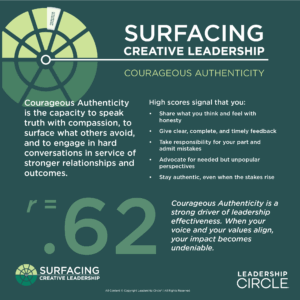
Courageous Authenticity is the Creative Competency that reflects a leader’s willingness to take personal risks for the sake of the work and the relationships that make the work possible. Leaders high in this dimension don’t just “speak up”—they speak truth in a way that strengthens alignment, deepens trust, and helps everyone make meaningful progress.
High scorers in this dimension tend to:
- Name issues others avoid—gently, clearly, and without blame.
- Express what’s real for them with intention and care.
- Share perspectives transparently, even when it’s uncomfortable or inconvenient.
- Invite honest dialogue and make it safer for others to bring their full truth forward.
- Stay self-aware enough to know when they’re speaking in service versus speaking from fear or frustration.
This isn’t fearless leadership. It’s values-aligned leadership. It’s a choice to show up as your real self—not recklessly or dramatically, but responsibly—in service of outcomes that matter.
The data backs this up. Courageous Authenticity has a strong correlation with leadership effectiveness (r = .62). Leaders who engage in honest, grounded, transparent conversations consistently drive stronger results. Why? Because clarity accelerates alignment. Trust accelerates execution. And truth, handled well, accelerates everything.
This dimension is more than a communication skill. It’s often the difference between adequate performance and great performance.
🎥 Dive into the data through Data Wizardry with Joseph Leman.
Why This Dimension Matters
Have you ever caught a colleague’s eye across the room during a meeting—one of those here we go again glances—and known instantly that the real conversation was going to happen afterward? In the hallway. By the coffee machine. On the walk to the parking lot. Anywhere but in the room where the actual decisions were supposed to be made.
We’ve all been part of the “meeting after the meeting.”
And we all know why it happens: people don’t feel safe telling the truth in the moment. They stay defended. They protect themselves. They protect relationships. They protect the leader’s ego—or their own. And the whole system moves around what’s unsaid.
The cost of all this unspoken truth is real. When leaders and teams spend their time managing comfort instead of reality, meetings go nowhere. Issues stay unaddressed. Alignment becomes performative. And eventually, the truth leaks out sideways—in whispered conversations, in frustration, in disengagement. As Leadership Circle CEO Bill Adams said in a recent conversation with Chief Knowledge Officer Bob Anderson, “If you’ve spent all your time in meetings not telling the truth, you’ve never had a meeting that gets anywhere.”
Courageous Authenticity interrupts this dynamic. It shifts the environment from polite avoidance to grounded honesty. It creates a place where people can hear something they may not want to hear, offer feedback that might be uncomfortable, or surface an insight that could change the direction of the work. Not to provoke, not to “be bold” for its own sake, but because the truth clears a path.
And yet—realness doesn’t mean raw. Courageous Authenticity isn’t about emotional dumping, blunt force honesty, or saying whatever you feel in the moment. It’s truth with intention. It’s candor with care. It’s the Creative stance that strengthens trust because it honors both the relationship and the reality.
When leaders show up this way, something shifts. People exhale. Meetings become places where real work happens. And the “meeting after the meeting” becomes unnecessary—because the truth is finally allowed to live in the room where it belongs.
🎥 Watch the full conversation with Bill and Bob.
What It’s Not: Common Misconceptions
Even with all its benefits, Courageous Authenticity is one of the most misunderstood dimensions in the Leadership Circle Profile. Many leaders hear the word authenticity and imagine something far more dramatic—or far less skillful—than what this dimension actually reflects.
They assume it means being blunt, bold, or confrontational. Worse, they often double down on Courageous Authenticity as justification for a kind of unfiltered transparency that leaves no room for discernment. That behavior, what we might term reckless authenticity, isn’t grounded in honesty. It’s steeped in pride and arrogance.
Courageous Authenticity often gets confused with a few familiar (and unhelpful) patterns. Here’s what it isn’t:
- It’s not brutal honesty. Honesty without compassion is a form of self-protection.
- It’s not emotional dumping. Sharing everything you feel isn’t the same as leading.
- It’s not contrarianism. Challenging others for the sake of being “bold” is Reactive, not Creative.
- It’s not always dramatic. Sometimes Courageous Authenticity sounds like a simple, grounded truth: “I need help,” “I’m not OK with this,” or “Something feels off—can we talk about it?”
Think of it this way: Embodying Courageous Authenticity isn’t a free pass to speak without filters or act without regard for impact. It’s the ongoing discipline of bringing your real self forward in a way that serves both you and the system, team, or organization you’re leading. It’s courage plus care.
From Reactive to Creative: The Role of Courageous Authenticity
Reactive Tendencies often show up as conflict avoidance, people-pleasing, controlling the narrative, or withholding perspectives until frustration boils over. All of these patterns keep leaders—and teams—stuck in unproductive conversations and meaningless back-hall chatter.
Acting with Courageous Authenticity is one of the key unlocking moves that shifts leaders out of Reactive patterns. It brings us back into alignment with purpose, values, and relationship.
“The key here is to get courage and compassion together,” said Bob in his conversation with Bill. “Courage without compassion is aggression and compassion is a high form of courage.” This integration is what moves Courageous Authenticity from a personality trait to a powerful Creative discipline.
🎥 Watch the full conversation with Bill and Bob.
When leaders bring courage and compassion together, they interrupt blame and resentment before they harden, redirect their energy from self-protection toward service of the whole, and turn potential conflict into connection and clarity. It’s a shift from fear-driven silence to value-driven communication—one that opens the door to more honest dialogue, deeper trust, and stronger alignment.
This is the Creative stance: truth paired with care, courage expressed through compassion, and communication that strengthens the system rather than simply protecting the self.
Leveraging Courageous Authenticity: Practices + Prompts
Courageous Authenticity deepens when leaders develop the muscle to name truth—internally and externally—in steady, relational ways. But it isn’t always easy to get started, especially with a dimension that can threaten to open us up for ridicule or shame. That’s why we recommend building a practice of Courageous Authenticity—to help solidify your regular practice of conscious leadership.
Here are a few ways to practice:
- Start conversations with what’s true for you right now.
- Notice moments when you choose comfort over clarity—and reverse the pattern.
- Practice naming the “thing beneath the thing” in low-stakes contexts.
- Share your intentions before sharing hard truths.
- Ask for feedback on how your communication lands.
- Pause before responding: “Am I speaking from fear or from purpose?”
- Make one small, courageous move each week.
Prompts for reflection:
- What truth am I avoiding, and what is the cost of that avoidance?
- What part of me am I protecting by staying silent?
- What outcome matters most right now, and what truth would support that outcome?
- How can I communicate this in a way that strengthens relationship, not erodes it?
- What courageous act could I take today that my future self would thank me for?
Curious how this dimension shows up in leadership and coaching moments?
🎥 In a recent webinar, Leadership Circle coaches Carolina Páez, María Becerro, and Zana Petricevic explored how Courageous Authenticity shapes leaders’ everyday choices—and how bringing grounded truth into the room can transform team dynamics, deepen trust, and accelerate meaningful action.
Recommended Reading
Want to explore more about brave, grounded truth-telling in leadership? These books offer powerful perspectives on how real dialogue, self-awareness, and connection shape healthy leadership.
- Leadership and Self-Deception by The Arbinger Institute
A powerful look at how self-protection distorts our relationships and decision-making. - Crucial Conversations by Patterson, Grenny, McMillan, and Switzler
A roadmap for navigating high-stakes conversations with clarity and skill. - Immunity to Change by Robert Kegan and Lisa Lahey
A transformative framework for understanding the hidden commitments that keep us stuck. - Radical Candor by Kim Scott
A guide to caring personally while challenging directly, rooted in real-world leadership practice. - Nonviolent Communication by Marshall Rosenberg
A foundational method for communicating with both honesty and compassion.
Final Thoughts: Truth-Telling as Leadership
Courageous Authenticity asks us to stand in our truth with intention, humility, and heart. It invites us to disrupt the patterns that keep us small and, instead, choose conversations that move us—and those we lead—toward possibility.
In a world that rewards polish and performance, Courageous Authenticity is a quiet, radical act.
It says: I’m willing to be real. I’m willing to be seen. And I’m willing to serve what matters most.





I love how the article dives into the dynamics of Courageous Authenticity—it’s such an important concept for today’s leaders. The distinction between spoken and unspoken conversations is something we often overlook, but it’s crucial for fostering real, meaningful engagement within teams.
Fantastic resource. Do you offer a PDF version of this post?
Very helpful explanation — I learned several useful techniques.
Well-researched and balanced. Appreciate the effort behind this.
Thanks for the practical tips — they made a real difference for me.
I appreciate the step-by-step instructions. They made implementation easy.
That’s a solid point about team synergy!