
We’re diving deep into the dimensions of the Leadership Circle Profile®—one at a time—to surface insights, get curious, and explore how each dimension helps leaders move from Reactive to Creative leadership. In this post, we’re unpacking Personal Learner—the mindset that amplifies your leadership impact and lifts your growth to new levels.
What if the most powerful catalyst for your leadership potential wasn’t a new tool, framework, or strategy—but a deeper commitment to your own growth?
That’s the essence of Personal Learner: a Creative leadership dimension that measures your willingness to look inward, reflect honestly, and continually evolve. More than a competency, this dimension represents a posture—a mindset of humility, curiosity, and commitment to becoming all you are capable of being.
At a time when leaders face unprecedented complexity, the most effective among us aren’t the ones who know the most. They’re the ones who are most willing to keep learning.
What Do We Mean by Personal Learner?
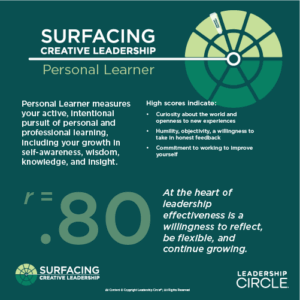
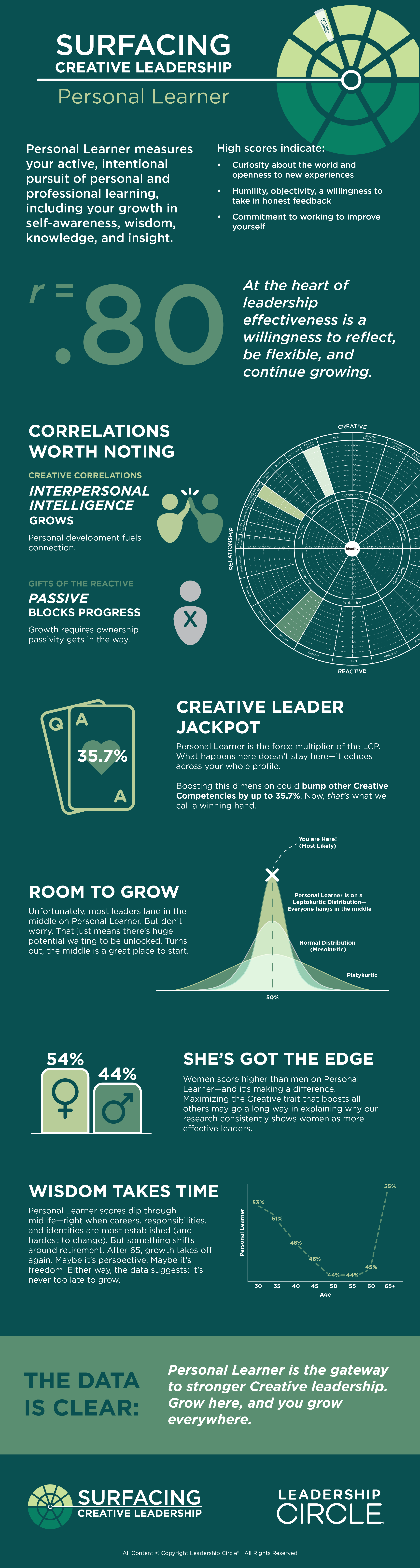
Personal Learner measures how actively and intentionally you pursue growth—both professionally and personally. This isn’t about following the whim to master your sourdough starter or bingeing self-help books. It’s about the ongoing, sometimes uncomfortable, always essential process of learning through experience, reflection, feedback, and practice.
High scorers in this dimension tend to:
- Seek honest feedback (even when it stings)
- Reflect on both success and failure
- Engage in practices that build wisdom and insight
- Choose experiences that expand their perspective
- Stay open to change, even when it challenges their identity or status
In leadership, this shows up as a growth mindset that permeates everything. Personal learners don’t assume they’ve arrived; they model humility and resilience. They adapt faster. They listen better. They shape cultures where learning is safe, encouraged, and expected.
This connection to leadership effectiveness isn’t just theoretical—it’s one of the most data-rich insights we’ve surfaced. Personal Learner correlates with overall leadership effectiveness at an impressive r = .80, making it one of the strongest predictors of effectiveness across the entire profile.
The data backs this up. Personal Learner isn’t just another dimension. It’s a force multiplier. When leaders grow here, the impact radiates outward. In fact, increasing Personal Learner scores has been shown to boost other Creative Competencies by more than 35%. It’s a small lever that moves a big system.
Why This Dimension Matters
Leadership today is less about having the right answers and more about navigating ambiguity, complexity, and change. That requires a kind of internal agility—and that agility is cultivated through learning.
The best leaders don’t see learning as optional. They see it as oxygen. They’re not afraid to say, “I don’t know yet.” They approach situations with openness rather than certainty. And because of that, they grow faster—and bring their teams along with them.
In short: The best leaders are learners.
What It’s Not: Common Misconceptions
That said, it’s easy to misunderstand what Personal Learner is really about. In fact, this dimension can often be overlooked, oversimplified, or mischaracterized, mistaken for things like intellectual curiosity, academic achievement, or professional development plans. But it goes much deeper than that.
Let’s clear up a few myths:
- It’s not just about being book smart.
Personal Learner is about how you engage with life—not how many degrees you have or how many leadership books you’ve read. - It’s not the same as professional development.
This isn’t about checking boxes on a training plan. It’s about cultivating the self-awareness and practices that support whole-person development. - It’s not a luxury.
Some leaders treat self-reflection and personal growth as nice-to-haves—things they’ll get to when the five-alarm fires are over. But in reality, it’s exactly those practices that equip them to lead through the fire.
From Reactive to Creative: The Role of Personal Learner
When we operate from a Reactive mindset, we often protect our sense of self by avoiding discomfort. We might deflect feedback, over-rely on what we already know, or default to controlling behaviors. Growth feels risky, so we resist.
Personal Learner challenges that instinct. It invites us into discomfort—in service of fulfilling our purpose. It softens our defensiveness, turns feedback into fuel, and allows us to shift from proving to improving.
In their recent conversation on Personal Learner, Leadership Circle Co-Founders Bill Adams and Bob Anderson reflected on what it takes to truly grow. It requires an “honest assessment of self,” Adams says. “Do I enter any given situation to learn from that situation, or do I enter knowing that I’ve got all the answers? How self-aware am I, and what do I pay attention to?”
That kind of growth doesn’t require a coach or a formal process. It begins with humility, curiosity, and the courage to face discomfort head-on. When we’re willing to quiet our defensiveness and look beneath our reactions, we create the conditions for real learning. That’s not just emotional intelligence—it’s the inner work of leadership.




It’s refreshing to see ‘Personal Learner’ framed not as a competency but as a mindset. That distinction really resonates, especially in a time when adaptability and self-reflection feel more critical than ever in leadership.