We’re diving deep into the dimensions of the Leadership Circle Profile—one at a time—to surface insights, get curious, and explore how each dimension helps leaders move from Reactive to Creative leadership. In this post, we’re unpacking Interpersonal Intelligence—the Creative Competency that reflects how effectively you listen, engage in conflict and controversy, deal with the feelings of others, and manage your own emotions and reactions.
Picture this: You’re in a meeting and say something that lands wrong. You pushed back on a team member’s idea or offered feedback that was a little harsher than you intended.
The room gets quiet. Your chest tightens. Even though nothing catastrophic has happened, you’re suddenly on damage control. You feel the heat rise up the back of your neck. Your mind races, thinking of a hundred ways you could defend, correct, or retreat.
You start rehearsing your response instead of listening and move into explanation mode. You begin building your case. Maybe you get louder. Maybe you go quiet. Maybe you mentally leave the room altogether while your body politely remains in the chair.
Interpersonal Intelligence lives in that moment—not before tension arrives, and not after everyone has calmed down. Right there, in the middle of that conversation.
Some leaders push through on the sheer force of their logic or authority. Others smooth things over and move on. Creative leaders stay in the moment, even (and especially) when it’s uncomfortable. They are present, curious, and grounded enough to remain in relationship while the conversation is still unfolding.
These leaders are not trying to be perfect, they just have to be willing to stay in the conversation. Interpersonal Intelligence helps leaders do just that. It’s a real-time leadership capacity that shows up when the stakes are high, when things get personal, and when the outcome isn’t guaranteed.
What Do We Mean by Interpersonal Intelligence?
Within the Leadership Circle Profile, Interpersonal Intelligence reflects a leader’s capacity to listen deeply, navigate disagreement skillfully, and build trust through honest, respectful relationships.
At its core, it’s about staying connected—to yourself and to others—especially when conversations become challenging. Leaders high in Interpersonal Intelligence don’t avoid disagreement, nor do they overpower it. They can advocate for their point of view while remaining genuinely open to perspectives that differ from their own.
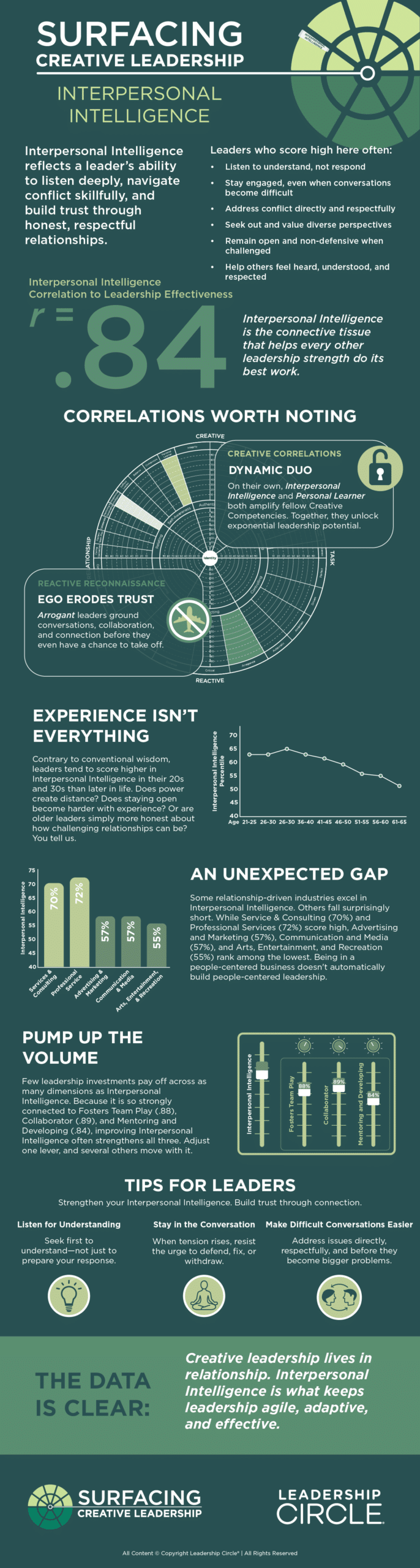
This dimension sits high in the Relating inner dimension for a reason. It requires presence, self-command, and the ability to hold tension without collapsing into defensiveness or control. It reflects how effectively leaders:
- Listen to understand rather than to respond
- Stay engaged when conversations become difficult
- Address conflict directly and respectfully
- Remain open when challenged or criticized
- Help others feel heard, understood, and valued
- Manage their own emotional reactions in the moment
The data backs this up. Within the Leadership Circle Profile database, Interpersonal Intelligence demonstrates one of the strongest relationships with leadership effectiveness of all the dimensions. The connections don’t stop there. Interpersonal Intelligence also shares strong relationships with other Creative Competencies, particularly Collaborator, Fosters Team Play, and Mentoring and Developing.
This suggests something important. Interpersonal Intelligence doesn’t behave like a standalone leadership skill. Instead, it functions more like connective tissue. When leaders become better listeners, conflict becomes more productive than destructive. Trust increases. Collaboration improves. And as a result, development, accountability, and performance become easier to sustain.
🎥 Dive into the data through Data Wizardry with Joseph Leman.
Why This Dimension Matters
No one achieves anything alone. Leadership, like life, is relational. And relationships can get sticky. People bring their emotions, assumptions, histories, ambitions, and fears into every room they enter. Interpersonal Intelligence helps leaders work with that reality instead of around it.
At the individual level, it shapes how a leader experiences challenge. Can you receive feedback without shutting down? Can you hear criticism without making it personal? Can you stay engaged when emotions—yours or someone else’s—enter the room?
At the team level, it influences psychological safety and trust. Teams led by leaders with strong Interpersonal Intelligence tend to surface issues earlier, address conflict more directly, and recover faster when things go wrong.
At the organizational level, it becomes a multiplier. Strategy, innovation, and execution all depend on conversations—often difficult ones—happening with enough honesty and respect to move work forward rather than fracture relationships.
Many leaders become more technically capable as they advance in their careers. Fewer become more skillful in relationship at the same rate. Yet the higher leaders rise, the more their effectiveness depends on their ability to influence, align, coach, and collaborate through others.
Bob Anderson calls out how a lack of Interpersonal Intelligence makes it harder for leaders to be skillful, let alone effective. “The more reactive I am, the more difficult it is for me to own (that reactivity)—which is a key piece of Interpersonal Intelligence,” he says. It’s essential for leaders to be able to see that “I’m part of the problem.”
🎥 Watch the full conversation with Bill and Bob.
Without this capacity, leadership effectiveness tends to erode—and not for the reason you think. It’s not because leaders lack insight or ambition, but because their relationships slowly constrict under pressure. Eventually, leadership becomes less about having the answer and more about creating the conditions for better answers to emerge. Interpersonal Intelligence sits at the center of that work.
What It’s Not: Common Misconceptions
Sometimes, Interpersonal Intelligence is mistaken for being agreeable or conflict avoidant. They are not the same. In fact, leaders with strong Interpersonal Intelligence don’t avoid difficult conversations. They lean into them. They have more of them. The difference is they tend to have those conversations in ways that preserve dignity for all involved and strengthen trust rather than degrade it.
Many assume the skill set associated with Interpersonal Intelligence belongs exclusively to extroverts or highly social leaders. It doesn’t. Some deeply introverted leaders score high here. It’s less to do with being a social butterfly than with having presence. It’s entirely possible to be quiet, reserved, and remarkably skilled in relationship.
One more common misconception about Interpersonal Intelligence is that it’s just another term for emotional intelligence, or EQ. While both deal with managing emotions skillfully, Interpersonal Intelligence is more about how you deploy yourself in potentially high-emotion situations. Specifically, listening well, asking questions to understand, setting healthy boundaries, and advocating for your position with respect and an open mind.
Interpersonal Intelligence is best understood as disciplined openness—the ability to remain both honest and connected when it would be easier to choose one or the other.
From Reactive to Creative: The Role of Interpersonal Intelligence
When leaders become reactive, Interpersonal Intelligence is often one of the first capacities to disappear. Curiosity gives way to certainty. Asking questions becomes starting arguments. Listening to understand goes out the window.
Depending on our preferred Reactive pattern, we may dominate the conversation, smooth over tension, withdraw completely, or become overly focused on protecting ourselves. The external behavior varies, but the internal experience is often the same. Once we feel threatened, the conversation stops feeling collaborative and starts feeling personal.
Creative Interpersonal Intelligence invites a different response. Instead of asking, How do I protect myself here? the question becomes, What is this situation asking of me?
Maybe the answer is advocacy. Maybe accountability. Or maybe it’s simply remaining in the conversation long enough to hear something you didn’t expect to hear.
When leaders lean into Interpersonal Intelligence, control gives way to trust—trust in one’s capacity to stay present and respond skillfully. Over time, this shift builds something durable: long-term relational capacity that outlasts any single interaction or outcome.
But don’t expect this shift to be a swift one. Or that once made, it’s made forever. Effective leaders continually work on the awareness and presence required to be interpersonally intelligent. “Every day, all day long,” Bill Adams says in his conversation with Bob Anderson about the dimension. “We are in that practice field with self and other every day, all day long. It’s a practice field.”
🎥 Watch the full conversation with Bill and Bob.
Leveraging Interpersonal Intelligence: Practices + Prompts
When emotions rise, resist the urge to exit—physically or psychologically. Name what’s happening and stay engaged. Like every Creative Competency, Interpersonal Intelligence can be developed.
Practices:
- Listen for what matters, not just what’s said. What concern, value, fear, or aspiration sits underneath the words?
- Notice your internal reactions. Where do you become defensive, impatient, eager to fix, or tempted to withdraw?
- Paraphrase before responding. Can the other person recognize their perspective in your summary of it?
- Address issues early. Most difficult conversations only get tougher when they’re delayed.
- Stay curious under pressure. Curiosity often disappears precisely when we need it most.
Prompts for reflection:
- What kinds of conversations make it hardest for me to stay open?
- When challenged, what is my first instinct: defend, persuade, fix, withdraw, or something else?
- Where might I be listening for agreement instead of understanding?
- Whose perspective have I stopped being curious about?
- What conversation am I postponing that would benefit from courage and care?
Curious how this dimension shows up in leadership and coaching moments?
🎥 In a recent webinar, Leadership Circle coaches Claudia Presber and Izabela Starchurska discussed how leaders can build the capacity to listen deeply, engage in conflict and controversy with respect, and draw out others’ positions and emotions.
Recommended Reading
For leaders exploring the dynamics beneath Interpersonal Intelligence, these resources offer helpful insight into approval-seeking, boundaries, authenticity, and courageous leadership:
- Crucial Conversations: Tools for Talking When Stakes Are High by Kerry Patterson, Joseph Grenny, Ron McMillan, and Al Switzler
Tips and tools to help you communicate clearly in life’s most difficult and important conversations and achieve the positive resolutions you want. - Thanks for the Feedback: The Science and Art of Receiving Feedback Well by Douglas Stone and Sheila Heen
Blending insights from neuroscience and psychology with practical advice, this book offers a simple framework for accepting unsolicited input with curiosity and grace. - Nonviolent Communication by Marshall Rosenberg
A way of looking at communication as a means to find common ground with anyone at any time. - Leadership and Self-Deception: The Secret to Transforming Relationships and Unleashing Results by The Arbinger Institute
Exposing the hidden patterns that sabotage our best intentions, this book shares tools to help people-related dysfunction at work, at home, and in life.
Each offers a different lens on conflict, communication, and relationship, but all return to a similar truth: The quality of our leadership is inseparable from the quality of our conversations.
Final Thoughts: Stay in the Conversation
Interpersonal Intelligence is sometimes described as being “good with people,” but that description feels too small. This dimension is all about what happens when conversations become uncertain, emotional, complicated, or consequential.
Can we stay open? Can we remain curious? Can we tell the truth without making someone else wrong?
Creative leadership leans into these conversations. It asks us to become more skillful inside of them. More present. More patient. More personal. But it’s not enough just to know that relationships matter.
Creative leadership is, itself, a relational act. Vision, courage, systems thinking, mentoring, collaboration—all of it happens through and with other people. Interpersonal Intelligence is the connective tissue that keeps leaders nimble and the mechanism that allows us to be adaptive and our most effective in the real world.