
Exceptional leadership is not an innate trait; it is a meticulously cultivated capability. For decades, organizations have sought the secret formula for developing effective leaders, often pouring vast resources into isolated training events with mixed results. The reality is that true leadership development happens not in a vacuum, but in the trenches of daily work, guided by a proven framework of experiential learning, relational support, and formal education.
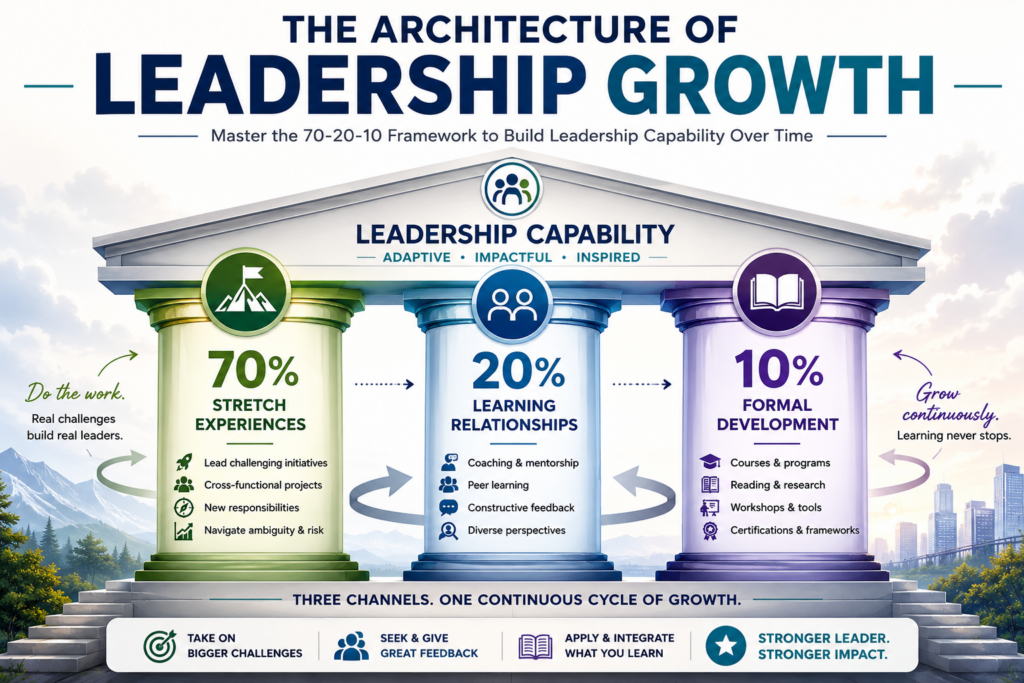
We often recommend a 70-20-10 framework. This method provides a clear architecture for leadership growth. It posits that leaders acquire their capabilities through three primary channels: 70% from stretch experiences, 20% from learning relationships, and 10% from formal development. Understanding and intentionally applying this balance allows you to transform everyday business challenges into powerful engines for professional growth.
Here is how you can leverage these three channels to build leadership capability over time through practice, reflection, and strategic support.
The Engine of Growth: 70% Stretch Experiences
The most profound leadership lessons are forged in the fires of actual business challenges. When you step outside your comfort zone to tackle unfamiliar problems, you engage in the highest form of active learning. Stretch experiences force you to adapt, innovate, and develop new mental models.
Stepping Outside the Comfort Zone
Not all experiences yield equal learning. Routine tasks build efficiency, but complex, high-stakes assignments build leadership. To harness this 70%, leaders must actively seek out, or be assigned, roles that demand capabilities they have not yet mastered. This might involve leading a turnaround initiative, managing a cross-functional team, or taking on a project with a significantly expanded scope.
When you place yourself in these demanding environments, you are forced to navigate ambiguity and make decisions with incomplete information. This friction is exactly what builds leadership muscle.
Turning Experience into Expertise
Experience alone does not guarantee growth; reflection is the mechanism that converts experience into lasting expertise. Leaders must develop the discipline to pause and analyze their actions. What worked? What failed? How did the team respond to a specific directive? By systematically extracting lessons from both successes and failures, you build a customized playbook for future challenges.
Talent development professionals can facilitate this by designing roles that inherently require problem-solving and by ensuring leaders have the operational latitude to test new approaches.
The Catalyst of Connection: 20% Learning Relationships
No leader develops in isolation. The middle tier of the growth framework centers on the interactions, feedback, and guidance derived from other people. This 20% is critical because it provides the mirror through which leaders can accurately view their own performance and impact.
The Power of Perspective
Learning relationships take many forms: managers, executive coaches, mentors, and peers. These individuals offer diverse vantage points that help you identify blind spots and challenge your assumptions. A mentor might share insights from a similar career transition, while a peer can provide real-time feedback on how your communication style is landing in executive meetings.
To maximize this channel, you must actively cultivate a network of trusted advisors. This requires vulnerability and a genuine willingness to hear constructive criticism.
Cultivating a Feedback-Rich Environment
For organizations, fostering this 20% means shifting the culture from one of evaluation to one of continuous development. Feedback must become a regular, expected part of the weekly cadence rather than an annual event. When leaders surround themselves with people who are committed to mutual growth, the lessons learned during the 70% stretch experiences are rapidly contextualized and integrated.
The Foundation of Frameworks: 10% Formal Development
While it represents the smallest percentage of the framework, formal development is the foundational mortar that holds the rest of the learning architecture together. This 10% encompasses structured coursework, leadership training programs, reading, and academic study.
Structured Learning as an Accelerator
Formal development provides the theoretical frameworks, shared vocabulary, and best practices that make on-the-job learning more efficient. Before you lead a complex change initiative (your 70%), understanding the psychology of change management through a formal course (your 10%) gives you a critical head start. It prevents you from having to reinvent the wheel.
Amplifying the 90 Percent
The true value of the 10% lies in its amplifier effect. Well-designed coursework clarifies and boosts the other 90% of your learning. It gives you concrete tools to practice in your daily work and structured paradigms to discuss with your mentors. When aligned correctly, formal training serves as the catalyst that activates deeper insights during everyday operations.
Integrating the Framework for Talent Development
To build a robust pipeline of capable leaders, organizations must move beyond the classroom and engineer environments where the 70-20-10 model occurs naturally.
- Audit existing development plans: Ensure that development goals are tied directly to current or upcoming business initiatives, not just future aspirations.
- Build a culture of debriefing: Institute regular post-mortem discussions on major projects to extract the learning value from the work itself.
- Align formal training with immediate application: Deliver training right before a leader steps into a stretch assignment, ensuring the 10% immediately supports the 70%.
Building Your Leadership Legacy
Leadership growth is a deliberate, ongoing process of testing your limits, seeking guidance, and grounding your actions in proven frameworks. By embracing stretch assignments, actively soliciting diverse perspectives, and utilizing formal training to amplify your practical experience, you construct a resilient foundation for long-term success.
Take a critical look at your current developmental trajectory. Identify one area of your daily work where you can push beyond your comfort zone this week, and seek out a colleague to provide honest feedback on your approach. True leadership is built one experience at a time.