
AI transformation keeps stalling in your organization, and it’s not because the technology isn’t ready.
The real friction sits in how you lead, what you own, and what you’ve delegated away. If you’re still waiting for IT to “come back with a plan,” you’ve already stepped out of the driver’s seat.
This guide is for C-suite leaders who intend to own AI transformation as a strategic mandate, not a side project.
- What AI Transformation Leadership Actually Means (And What It Isn’t)
- Why AI Transformations Stall: The Five Failure Modes Executives Own
- Four Operating Models For AI Transformation
- Governance And Talent: The Two Levers That Determine Whether AI Scales
- Your 90-Day AI Transformation Leadership Roadmap
- Key Principles For Lasting AI Transformation Impact
- Frequently Asked Questions About AI Transformation Leadership
What AI Transformation Leadership Actually Means (And What It Isn’t)
AI transformation leadership is an executive responsibility, not a technology project you push down the org chart.
It belongs in the same category as M&A, market entry, and enterprise restructuring: work where you personally set direction, make trade-offs, and own the outcome.
In practice, that means you:
- Define strategic intent
- Set decision rights across functions
- Shape the operating model
- Hold the organization accountable with clear metrics and timelines.
Without that level of executive ownership, AI drifts into “innovation theater” pilots, proofs of concept, and slideware that never change how the business actually performs.
Research from Harvard Business Review’s 2026 executive survey shows a clear pattern: leaders remain bullish on AI, yet many still struggle to demonstrate tangible value. The gap isn’t enthusiasm; it’s disciplined leadership.
For a deeper look at how AI is reshaping leadership styles, the demands it places on executives go well beyond technology decisions.

Image Source: Prosci
| Ready to close the gap between AI ambition and real results? Explore how Leadership Circle helps C-suite leaders build the strategic clarity and ownership AI transformation demands. |
Why AI Transformations Stall: The Five Failure Modes Executives Own
AI transformations rarely fail because the technology doesn’t work.
They fail because leadership choices create fragmentation, confusion, or risk the organization can’t absorb.
Here are five failure modes you directly control:
Failure mode #1 – Delegating strategy to IT
Passing AI to the CIO and asking for a roadmap isn’t strategy. It’s abdication.
When AI sits solely in the technology function, business units wait for instructions, use cases stay narrow, and transformation remains “something IT is working on.” You get better tools, not a better business.
Failure mode #2 – Treating AI as a cost-cutting exercise
Efficiency matters. But if your only objective is cost reduction, you cap the upside from the start.
McKinsey’s 2025 State of AI survey found that roughly 80% of companies set efficiency as an AI objective. The organizations that pull ahead also use AI to drive revenue growth and differentiated customer experiences.
Failure mode #3 – No clear ownership structure
If you can’t answer “Who owns the AI roadmap?” in a single sentence, you don’t have an operating model. You have a coordination problem that compounds with every new initiative.
Failure mode #4 – Underinvesting in governance early
Leaders who treat AI governance as a “later” concern accumulate technical debt and compliance risk that make scaling painful. Practical guardrails — clear approval paths, model validation standards, risk thresholds — build the confidence teams need to move faster.
Failure mode #5 – Ignoring the talent gap
You can’t scale AI with only external consultants and a handful of data scientists. You need people who understand the business, the data, and the technology, and who can translate across all three.
Four Operating Models For AI Transformation
Most large organizations choose one of four operating models. The right choice depends on where AI creates the most value for you, how centralized your organization is, and how much change you can realistically manage from the top.
CEO-led transformation office
A dedicated transformation leader often a Chief AI Officer reports directly to the CEO and holds authority across functions. This removes ambiguity: AI can’t be deprioritized by mid-level politics when it lives in the CEO’s office.
Choose this model when AI sits at the center of your competitive strategy and you need the whole enterprise moving in the same direction, fast. The trade-off is executive bandwidth.
CIO- or CTO-led technology modernization
Your technology leader owns the roadmap, defines the platforms, and sets standards for AI integration. This works best when your priority is infrastructure: consolidating data platforms, modernizing legacy systems, and building shared services.
The risk is insularity. Pair your CIO or CTO with a senior business sponsor to keep the focus on outcomes, not just platforms.
COO-led process transformation
This model treats AI as a lever for operational excellence, redesigning core processes supply chain, claims, service operations with AI embedded where it removes friction. The COO already owns these workflows, so accountability is unambiguous and frontline adoption tends to be higher.
The risk is optimizing the current business without questioning its boundaries.
Federated business-unit model with central guardrails
Business-unit leaders own their AI roadmaps and execution while a central group defines non-negotiable guardrails for data, ethics, security, and shared platforms. This suits diversified enterprises with different markets and regulatory environments.
Without strong guardrails, fragmentation follows; without trust in business units, you slide back into a centralized model with added bureaucracy.
| Not sure which operating model fits your organization? Take the Leadership Circle Profile to surface the leadership patterns shaping your AI transformation decisions. |
Governance And Talent: The Two Levers That Determine Whether AI Scales
Most AI strategies talk about tools and platforms. The programs that actually scale obsess over governance and talent.
Governance: ambition meets accountability
Without clear governance, AI work turns into a patchwork of pilots no one fully owns. Effective AI governance answers three questions up front:
- Who decides? The individuals or groups with authority to approve use cases, set risk thresholds, and allocate resources.
- How do we approve? The criteria and process for evaluating new ideas, including legal, ethical, and technical checks.
- How do we monitor? The mechanisms for tracking performance, bias, drift, and incidents over time.
Get those right and governance becomes a catalyst for speed, not a brake.
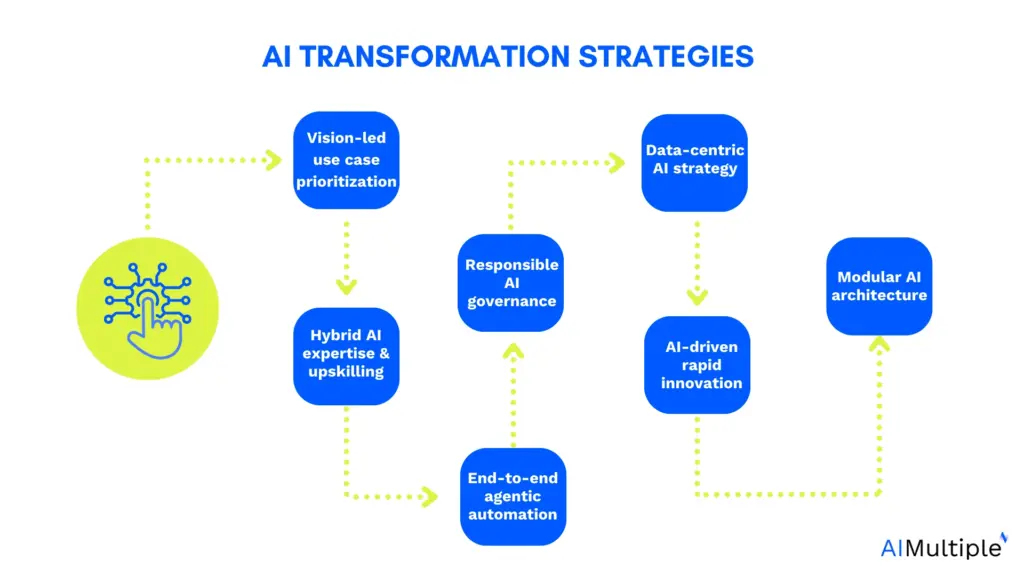
Image Source: AI Multiple
Talent: The Hidden Bottleneck
Technology vendors are easy to find. People who can connect AI models to meaningful business outcomes are not. Beyond data scientists, you need:
- Product-minded leaders who translate commercial priorities into AI-enabled offerings and features.
- Translators who bridge business and technical teams to frame problems, improve workplace collaboration, shape requirements, and interpret results.
- Change leaders who manage adoption, redesign roles, and handle the human impact of automation and augmentation.
Teams that consistently extract value from AI have all three roles in place and back them with the right productivity tools.
If you want AI to scale, invest as heavily in governance and talent as you do in platforms. Anything less is wishful thinking.
Your 90-Day AI Transformation Leadership Roadmap
You need a clear, time-bound sequence that moves you from aspiration to visible results while you still have executive attention and political capital. Here are three phases with defined ownership, deliverables, and decision points.
1. Establish strategic clarity and ownership
Your first 30 days set the ceiling for everything that follows.
Define what AI is for in your business right now: efficiency, growth, risk management, or customer experience. Choose a dominant theme and name two or three enterprise metrics AI must move in the next 12–18 months.
Assign a single accountable executive with unambiguous authority to make cross-functional trade-offs. Agree your governance model and operating model on a single page.
By Day 30, you should be able to explain your focus, model, and first bets in under five minutes to your board.
2. Stand up governance and identify high-value use cases
Days 31–60 are about moving from concept to structure.
Stand up a small AI steering group five to seven senior leaders from business, technology, risk, and legal with real authority to approve use cases and unblock issues. Refine your use-case list against three filters:
- Business value clear line of sight to revenue, cost, or customer metrics.
- Feasibility realistic given your current data, systems, and talent, with minimal new dependencies.
- Risk manageable downside if something fails, with appropriate human oversight.
Define success measures and baselines before writing a single line of code.
By Day 60, your use cases, governance mechanisms, KPIs, and resourcing plan should all be real, not theoretical.
3. Launch pilots, instrument KPIs, and build capability
Days 61–90 are about execution, learning, and visible wins.
Launch pilots with tight scopes and explicit success criteria. Track technical metrics (accuracy, latency, error rates), business metrics (cycle time, conversion, cost per case), and adoption metrics.
Use weekly check-ins to review data and remove obstacles. Don’t wait for a quarter-end review to discover nothing changed. In parallel, rotate high-potential leaders through AI projects and document what works.
By Day 90, you should know which pilots are ready to scale, which need another iteration, and which to stop.
The leadership capabilities required for AI-era transformation go beyond technical literacy. Building them now will pay off in every subsequent wave.
Key Principles For Lasting AI Transformation Impact
Technology choices change. These leadership principles don’t.
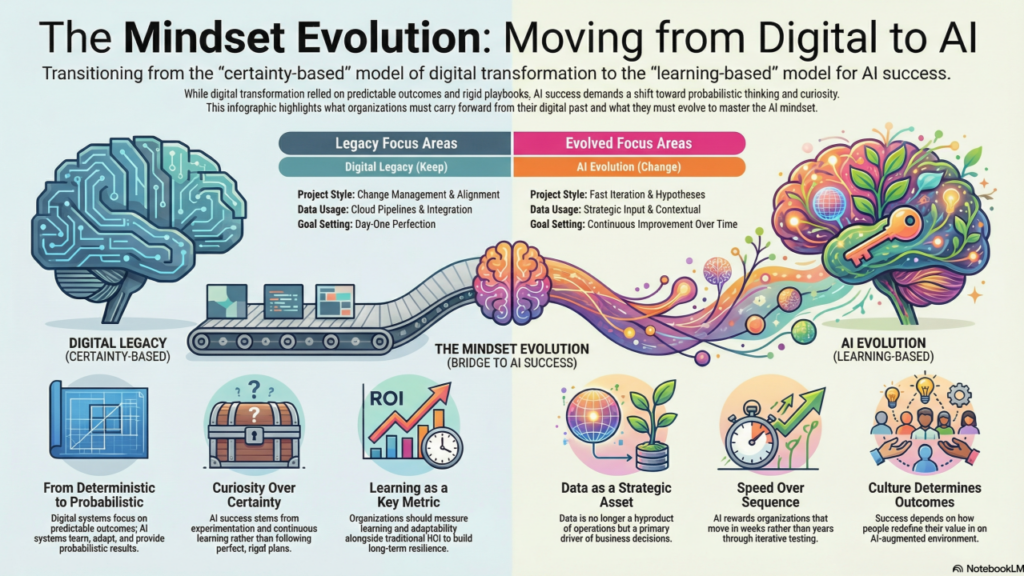
Image Source: LinkedIn
Five disciplines matter more than any specific tool or model:
- Lead with business outcomes Anchor every AI initiative to a small set of revenue, margin, risk, or customer metrics. Resist the temptation to measure success by models deployed or tools purchased.
- Make ownership explicit Assign a senior executive who owns AI impact and has real authority. Shared ownership sounds inclusive but usually leads to drift.
- Invest early in governance and talent Build decision frameworks and capability before you scale pilots. Retrofitting them after the fact is slower and costlier.
- Treat AI as a capability, not a product Vendors can accelerate you, but they can’t own your strategy. You need internal people who understand your context and can steward AI over time.
- Build tight feedback loops Use pilots to learn about your organization, not just the technology. Feed lessons about culture, process, and readiness back into your roadmap.
The difference between AI programs that plateau after a few pilots and those that reshape the business isn’t access to better algorithms.
It’s whether you apply these principles with rigor, and keep doing so long after the first wins.
Frequently Asked Questions About AI Transformation Leadership
Who should lead AI transformation: the CIO, CTO, or COO?
The right leader is the one closest to where AI will create the most strategic value for you, backed by a clear mandate across functions. If your priority is modernizing infrastructure and data, a CIO or CTO should own it. If you’re redesigning core operations, a COO is usually the best choice. When AI cuts across products, go-to-market, and operations, you’re in CEO-led transformation office territory. Title matters less than authority, credibility, and the ability to make binding decisions across silos.
What are the biggest reasons AI transformations fail?
AI transformations fail because of leadership gaps, not missing features in the tech stack. The most common issues are vague business outcomes, no single executive owner, weak or absent governance, and talent that’s too thin or too narrowly technical. McKinsey’s 2025 State of AI survey highlights how many companies chase efficiency without a clear strategy, while Harvard Business Review’s 2026 executive survey shows leaders remain bullish but struggle to show value. Both point directly to leadership discipline, not algorithm quality.
How do we govern generative AI safely without slowing innovation?
Govern generative AI by setting smart guardrails and fast decision paths, not by blocking experimentation. Start with a simple risk-tiering model: low-risk internal uses move on a fast track; high-risk, customer-facing, or regulated applications get deeper review and ongoing monitoring. Build controls into your platforms: data access, model choices, logging… so compliance happens by default. Done well, governance gives teams clarity and confidence, which actually speeds up responsible innovation.
Adriana Centeno is a guest contributor to the Leadership Circle blog.