

We’re diving deep into the dimensions of the Leadership Circle Profile—one at a time—to surface insights, get curious, and explore how each dimension helps leaders move from Reactive to Creative leadership. In this post, we’re unpacking Pleasing—the Reactive Tendency that reflects the extent to which a leader seeks approval, acceptance, or affirmation from others to feel safe, valued, or successful.
Have you ever been in a meeting when the group is divvying up next steps, and you’re desperately trying to avoid eye contact in the hope that—just this once—you’ll escape without adding yet another thing to your already alarming to-do list?
And then somehow, minutes later, you’re standing in the hallway while everyone cheerfully thanks you for “stepping up” and volunteering to take on the lion’s share of the project.
How did this happen? you scream internally.
But, if you’re honest, you know exactly how it happened.
Because when the room went quiet and everyone looked at you hopefully—waiting for someone to say yes—your brain performed a quick and costly calculation: Will they still like me if I say no?
The possibility felt unbearable. So, to quiet that voice, you said yes.
You may now be overworked, overwhelmed, and running entirely on caffeine and suppressed resentment. But at least everyone likes you.
Sound familiar?
Many leaders pride themselves on being easy to work with. They listen closely. They adapt quickly. They go out of their way to be supportive. In most organizations, those behaviors are rewarded—at least at first. People feel comfortable. Meetings stay calm. Tension stays low.
But over time, some leaders begin to notice the quieter cost of such behavior. They say yes when their capacity is already stretched. They hold back ideas that might create friction. They hesitate to challenge decisions they don’t fully agree with.
That tension sits at the heart of Pleasing.
What Do We Mean by Pleasing?
Because many Pleasing behaviors are socially rewarded, this pattern can be difficult to recognize. High-Pleasing leaders are often viewed as collaborative, thoughtful, supportive, and easy to work with. In many ways, they are.
But Pleasing is not the same thing as kindness. At its core, it’s a protective strategy—a way of stabilizing relationships and creating a sense of safety, belonging, or worth. The underlying belief is often quiet but powerful: If people are happy with me, I’m safe.
For leaders, Pleasing walks a fine line. It may preserve harmony in the short term, but it rarely produces strong leadership over time. Eventually, leadership becomes less about expressing what is most true, needed, or strategic—and more about managing approval and minimizing discomfort.
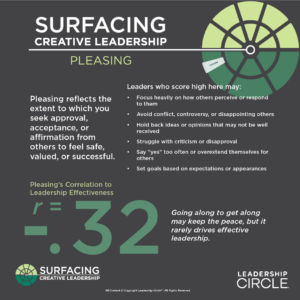
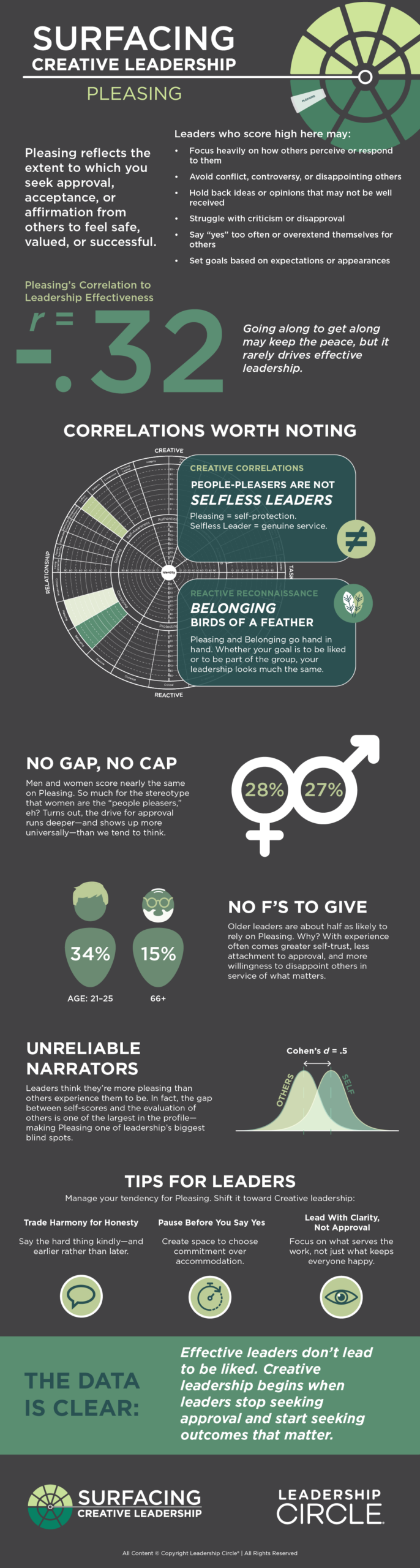
The data backs this up. With a correlation of r = -.32, Pleasing trends negatively with leadership effectiveness. Which is unfortunate news for those of us who built an entire personality around being agreeable.
Being supportive and collaborative absolutely contributes to healthy working relationships. But leadership also requires clarity, courage, accountability, and the willingness to disrupt the status quo when necessary.
The hard part is developing a habit of not caring what others think. Leadership requires empathy, awareness, and relational intelligence, to be sure. But the real challenge for Pleasing leaders begins when external validation becomes the primary driver of behavior.
Creative leadership asks something different of us: the ability to stay connected to others without losing connection to ourselves.
🎥 Dive into the data through Data Wizardry with Joseph Leman.
Why This Dimension Matters
Every leader eventually faces decisions that disappoint someone. Every meaningful strategy creates tradeoffs. Every healthy team needs honest feedback, productive conflict, and clear accountability. Innovation requires dissent. Transformation requires disruption.
In other words: if you’re going to lead people, at some point you’re going to make someone uncomfortable. Possibly yourself. Probably repeatedly.
When Pleasing drives leadership, those moments become difficult to navigate.
Instead of addressing issues directly, leaders may delay hard conversations. Instead of setting boundaries, they overextend themselves. Instead of making the difficult call, they continue seeking consensus long after clarity is needed.
Over time, teams can begin to experience mixed messages, unclear expectations, decision fatigue, or a lack of accountability—not because the leader doesn’t care, but because they care so much about preserving approval and avoiding relational discomfort. Pleasing leaders have made the choice to prioritize their own safety over the growth of the team and the people they lead.
Ironically, the very behaviors intended to maintain connection can slowly erode trust.
In their conversation on Pleasing, Leadership Circle co-founders Bob Anderson and Bill Adams discuss the challenge of holding this tension. “To risk disapproval was a fate worse than death,” Bob says of his own Pleasing behaviors. “I needed to be agreeable, always be loyal, nice, admired, thought highly of. And I was unable to lead, couldn’t challenge. I couldn’t champion things I really believed in.”
🎥 Watch the full conversation with Bill and Bob.
The hard (but welcome) truth: People don’t need perfect leaders. They need leaders who are clear, grounded, authentic, and willing to engage honestly.
The strongest leaders are not the ones who avoid tension. They are the ones who can stay relationally connected while moving through it.
What It’s Not: Common Misconceptions
Pleasing is often difficult to recognize precisely because many of its behaviors look positive on the surface. In organizations that value harmony, helpfulness, and agreeability, Pleasing can easily masquerade as emotional maturity—or even virtue.
But the distinctions matter.
Pleasing isn’t empathy. Empathy allows leaders to stay connected while holding firm boundaries. Pleasing sacrifices boundaries to preserve approval.
Pleasing isn’t collaboration. Collaboration invites diverse viewpoints. Pleasing avoids viewpoints that might disrupt harmony.
Pleasing isn’t selfless service. True service is grounded in choice. Pleasing is driven by fear of disapproval.
Pleasing isn’t kindness. Kindness is grounded in genuine care and generosity. Pleasing is often grounded in self-protection. One comes from wholeness; the other from fear of rejection, disapproval, or conflict.
Pleasing isn’t emotional intelligence. Emotionally intelligent leaders are aware of others’ emotions without becoming controlled by them.
Pleasing isn’t not humility. Humility allows leaders to listen, learn, and remain open. Pleasing can cause leaders to minimize their voice, withhold their perspective, or defer unnecessarily in order to avoid upsetting others.
None of this means Pleasing is “bad,” nor does it mean leaders should become harsher, colder, or less relational.
In fact, many of the strengths associated with Pleasing—empathy, generosity, attentiveness, collaboration—remain deeply important to Creative leadership.
The developmental work is learning how to express those strengths without becoming governed by the need for approval.
That’s the shift from Reactive to Creative leadership.
From Reactive to Creative: The Role of Pleasing
Like all Reactive Tendencies, Pleasing begins with a legitimate strength.
Many leaders developed this pattern early in life because it worked. Being accommodating, agreeable, helpful, perceptive, or relationally attuned may have created belonging, safety, or success. These leaders often become excellent teammates, trusted partners, and deeply caring managers.
The problem is not the original adaptation. The problem is remaining unconsciously governed by it.
The developmental shift with Pleasing is not about becoming less relational. It’s about reclaiming authorship.
Reactive Pleasing asks: Who do I need to be so others stay pleased with me?
Creative leadership shifts the center of gravity inward: What do I believe is needed here—and how do I express it with integrity?
As this shift unfolds, leaders begin to tolerate disappointment without collapsing into self-doubt. They discover they can care deeply and still say no. They learn that approval is not the same thing as trust—and that leadership often requires risking the former in service of the latter.
This trust is a key element to the dynamic between leaders and their teams and with each other. In his conversation about Pleasing with Bob Anderson, Bill Adams recalls a time in their partnership when Bob’s Pleasing quieted his voice “when I needed—even though I didn’t want it—when I needed Bob’s voice more than ever.” The absence of Bob’s voice affected the team. “Doesn’t mean we didn’t get results,” Bill says. “It means the cost of those results was high.”
🎥 Watch the full conversation with Bill and Bob.
Creative leaders still value relationships deeply. But they no longer organize their leadership around approval. They can engage in conflict without interpreting it as relational failure. They can say the hard thing compassionately and directly.
In fact, leaders high in Pleasing are often encouraged to work on their Courageous Authenticity as a core practice of moving from Reactive to Creative. And, as we know about Courageous Authenticity, it’s the ability to say the hard thing with heart.
That is a mantra any leader—but especially those high in Pleasing—can repeat to ground themselves in a mindset that will help them truly and consciously practice their own Creative leadership.
Instead of asking: “How do I keep everyone happy?”
Creative leadership asks: “What is most needed right now?”
That shift changes everything.
When leaders stop managing for approval, they create more space for honesty, accountability, innovation, trust, and authentic connection. Relationships often become stronger—not weaker—when leaders stop trying to constantly protect themselves from discomfort.
Leveraging Pleasing: Practices + Prompts
Growth beyond Pleasing does not require becoming harsher, colder, or less relational. It requires becoming more internally grounded. That work often starts with awareness.
Practices:
- Pause before you say yes. When a request comes in, pause before responding. Ask yourself: If approval were not at stake, what would I actually want to choose?
- Name the unsaid. In meetings and conversations, track what you’re not saying. Choose one moment to voice a thoughtful dissent or question.
- Notice when you manage reactions. Pay attention to moments where you rehearse conversations repeatedly before speaking, over-explain your decisions, avoid feedback conversations, or delay decisions because someone may be disappointed.
- Separate empathy from responsibility. You can care deeply about someone’s experience without becoming responsible for managing it.
- Practice small acts of Courageous Authenticity. Offer a dissenting opinion. Set boundaries without over-explaining them. Give direct feedback kindly. Every small act strengthens internal authority.
Prompts for reflection:
- Where am I trading my voice for approval?
- What am I afraid would happen if someone were disappointed in me?
- How do I know when I’m acting from care versus self-protection?
- Am I seeking agreement—or alignment?
- What would I say if I were not managing approval?
- What conversation would help create clarity?
Curious how this dimension shows up in leadership and coaching moments?
🎥 In a recent webinar, Leadership Circle coaches Yvonne Ingalls, Mike Kraft, and Keith Lewis explored a leader’s need for approval, acceptance, or external validation can shape the way they lead, communicate, and make decisions.
Recommended Reading
For leaders exploring the dynamics beneath Pleasing, these resources offer helpful insight into approval-seeking, boundaries, authenticity, and courageous leadership:
- The Courage To Be Disliked by Ichiro Kishimi and Fumitake Koga
A practical guide to the principles of self-forgiveness, self-care, and mind decluttering to help readers leave behind past trauma and societal expectations. - Leadership and Self-Deception: The Secret to Transforming Relationships and Unleashing Results by The Arbinger Institute
Explore the hidden patters that sabotage even our best intentions—in the workplace, at home, and in every relationship that matters. - Boundaries: When To Say Yes, How To Say No To Take Control of Your Life by Henry Cloud and John Townsend
A comprehensive and Christian faith-based look at setting boundaries for healthy relationships and personal growth. - The Empowered Manager: Positive Political Skills at Work by Peter Block
A road map for creating a more accountable, equitable, and empowering workplace culture.
Final Thoughts: Not a Flaw, a Signal
In leaders, Pleasing is a clue. It signals how they have learned to manage safety and belonging, and when brought into awareness, it becomes an invitation. An invitation to lead from internal authority, to stay relational without disappearing, and to offer clarity as a form of care.
Most leaders high in Pleasing don’t set out to manipulate outcomes or avoid responsibility. Quite the opposite. They care deeply. They want relationships to work. They want people to feel supported, included, and valued.
And while those are meaningful strengths, leadership eventually asks more of us than being liked.
Creative leadership demands we tell the truth with compassion. That we hold steady in difficult conversations and make decisions that serve the larger purpose, even if they disappoint some people. Creative leadership demands that we lead from inner conviction rather than external approval.
You don’t need to stop caring what people think; you simply need to stop being held captive by it.





This was a really insightful read. The distinction between genuine care and approval seeking was especially powerful. Learning to stay connected to others without losing connection to ourselves is a lifelong practice, and it’s one reason experiences like Sedona self love retreats can be so meaningful for developing greater self awareness and authenticity.