We’re diving deep into the dimensions of the Leadership Circle Profile—one at a time—to surface insights, get curious, and explore how each dimension helps leaders move from Reactive to Creative leadership. In this post, we’re unpacking Distance—the Reactive Tendency which reflects a leader’s tendency to create safety and maintain self-worth by staying emotionally removed, withholding vulnerability, and remaining detached from other people and difficult situations.
Seems like some leaders have all the answers.
They’re smart. Thoughtful. Calm under pressure. They see patterns others miss. They rarely get rattled. In meetings, they offer insightful observations. In crises, they’re unflappable. When things seem crazy, they appear unaffected.
And yet, it feels like something’s missing.
Their teams respect them, but don’t always feel connected. Colleagues appreciate their expertise but hesitate to disagree or debate. They’re often described as hard to know, difficult to read, or emotionally unavailable.
Welcome to Distance.
Distance is one of the most easily misunderstood dimensions of the Leadership Circle Profile. At first glance, it can look like professionalism, poise, independence, or even introversion. But beneath the surface, Distance reflects something different entirely.
Think of a duck floating along on a serene pond. Above the surface, the duck appears calm and in control. Below, its little webbed feet are working hard to keep it moving.
This is the tension at the heart of Distance. Leaders who score high in this dimension often appear steady, self-contained, and unaffected by the chaos around them. But beneath that composure may be a different story: an instinct to protect themselves from uncertainty, emotional discomfort, or vulnerability. And that protection can come at a cost.
Leadership is built through relationship. It requires leaders to be seen, to engage authentically, and to create space for others to do the same. When Distance becomes a habitual strategy, leaders may unintentionally create separation between themselves and the people they lead. Their expertise remains visible, but their humanity becomes harder to access. Their intentions may be positive, but their impact can leave others feeling disconnected.
That gap between intention and impact is where Distance becomes a leadership challenge.
What Do We Mean by Distance?
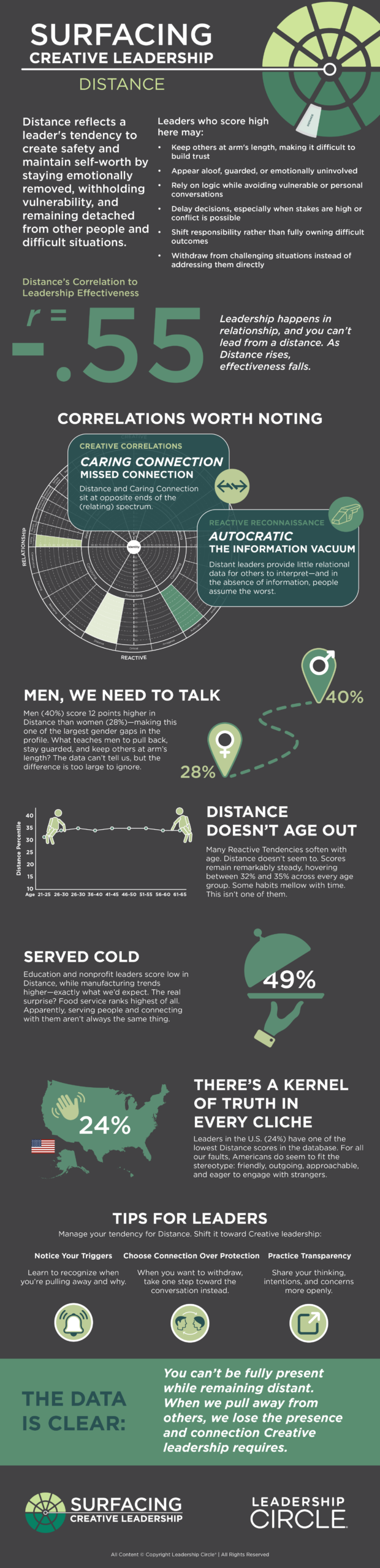
Distance measures the extent to which leaders establish a sense of personal worth and security by withdrawing from others, remaining emotionally detached, keeping people at arm’s length, or creating distance through expertise or authority.
At its core, Distance is a protective strategy. Rather than being vulnerable, feeling uncertainty or experiencing emotional discomfort, leaders high in Distance instinctively create space between themselves and others. They often rely on logic instead of emotion, keep conversations light and surface level, or withdraw entirely when relationships become uncomfortable. At issue isn’t the absence of heart, it’s the need to protect that heart.
Leaders who score high in Distance are often experienced as:
- Reserved, guarded, or difficult to approach
- Emotionally unavailable during challenging situations
- More comfortable with facts, logic, and analysis than emotions
- Hesitant to share personal perspectives or vulnerabilities
- More likely to withdraw from conflict than engage it directly
- Detached from difficult decisions or their impact on others
What’s important to understand is that leaders high in Distance are not uncaring. In fact, many care deeply about their people and their organizations. But distant leaders can unintentionally signal something very different. In fact, distance is almost always about maintaining a sense of safety, even though it often comes through as dismissiveness and even judgement.
This is the gap between intention and impact.
The data backs this up. Distance has a strong negative correlation with overall leadership effectiveness (r = -.55). In other words, as Distance increases, leadership effectiveness tends to decrease. Leadership is fundamentally relational. When leaders consistently protect themselves by creating distance, they limit the trust, connection, and influence that Creative leadership requires.
🎥 Dive into the data through Data Wizardry with Joseph Leman.
Why This Dimension Matters
Distance rarely shows up as a lack of competence. More often, it shows up as a lack of connection.
Leaders high in Distance are often thoughtful, composed, and exceptionally capable of seeing the bigger picture. They can remain steady when emotions run high, analyze complex situations objectively, and resist getting swept up in the urgency of the moment. Those are valuable leadership strengths.
The challenge isn’t the ability to step back. It’s knowing when to step back—and when to step in.
At the individual level, Distance shapes how leaders engage with themselves and others under pressure. Instead of leaning into vulnerability, difficult conversations, or emotional complexity, they may instinctively retreat into analysis, objectivity, or self-protection. The result isn’t a lack of caring. It’s that their care becomes harder for others to see.
At the team level, Distance can quietly erode trust. Team members may hesitate to bring forward concerns, share unpopular opinions, or ask for help because they aren’t sure their leader is fully present. Conversations become more transactional, conflict goes underground, and collaboration begins to suffer. Again, not because people don’t care, but because genuine connection becomes harder to access.
At the organizational level, the effects multiply. Culture is shaped by what leaders model. When leaders consistently remain emotionally guarded or inaccessible, others often follow suit. Communication becomes more cautious, relationships become more superficial, and the openness required for innovation, learning, and healthy accountability fades.
One of the most important insights from our conversation with Bill Adams and Bob Anderson is that Distance often begins as a strength. “I can step back and be an observer, witness what’s going on,” Bob said. “I can see what’s happening in the room or even see the larger systemic issues that are at play.” It’s the capacity to step onto the balcony, see the whole scene, and remain composed when others are caught in the drama of the moment.
🎥 Watch the full conversation with Bill and Bob.
The problem arises when observation becomes disconnection. What initially feels like strategic advantage can become withdrawal. For leaders, the goal isn’t to lose the perspective gained by stepping back. It’s to pair that perspective with presence. After all, Creative leadership requires both. The ability to see clearly matters. But so does the willingness to let people know they’re not facing a challenge alone.
When leaders become more accessible, emotionally present, and willing to engage authentically, they create the conditions for trust—and trust remains one of the most powerful accelerators of leadership effectiveness.
What It’s Not: Common Misconceptions
Because Distance can be difficult to spot, it’s often confused with other personality traits or leadership qualities.
Distance is not introversion. Plenty of introverts build deep, meaningful relationships and create strong cultures of trust. Needing solitude to recharge is not the same thing as emotionally withdrawing from others.
Distance is not Composure. Composure is the Creative counterpart to Distance. Composed leaders remain calm while staying connected. Distant leaders remain calm by disconnecting.
Distance is not intelligence. Many highly analytical leaders score low in Distance. The issue isn’t intellectual capability. It’s whether a leader uses analysis as a bridge to understanding or as a shield against vulnerability.
Distance is not healthy boundaries. Healthy boundaries allow leaders to remain connected while protecting their well-being. Distance creates separation. Boundaries support relationship.
The distinction matters because leaders often mistake Distance for professionalism, objectivity, or strength. The goal isn’t to become less thoughtful, less analytical, or less composed. It’s to remain fully present while bringing those strengths into your leadership. Great leaders don’t have to choose between perspective and relationship. They cultivate both.
From Reactive to Creative: The Role of Distance
Like every Reactive Tendency, Distance begins as an adaptive strategy. At some point, it served a purpose. It helps a leader navigate uncertainty, protect themselves, or maintain a sense of control in situations that felt emotionally risky.
The challenge is that strategies designed for self-protection rarely remain confined to the moments that first required them. Over time, they become habits. What once kept us safe can begin creating distance in relationships that no longer require that level of protection.
The goal, then, isn’t to eliminate Distance. It’s to become aware of it.
When it comes to building strategies to help us shift from a Reactive orientation to a Creative one, we often start with this mantra:
I have it. It doesn’t have me.
That awareness creates choice. In terms of Distance, leaders begin noticing when they’re pulling back, becoming emotionally unavailable, or retreating into analysis. Instead of staying there, they can pause, breathe, and intentionally step back into relationship.
Maybe that sounds straightforward, but in practice, it requires one of the most difficult moves in leadership: vulnerability.
“For those of us who throw off moderate to high Distance, vulnerability is akin to death,” Bill Adams said during his recent conversation with Bob Anderson on Distance. “Being undefended is an unlocking move that changes everything for the better.”
🎥 Watch the full conversation with Bill and Bob.
Being vulnerable doesn’t mean abandoning professionalism or composure. It means allowing yourself to be seen when every instinct tells you to stay guarded. It means remaining emotionally present in difficult conversations instead of retreating. It means trusting that openness creates stronger leadership than self-protection ever could.
As leaders make that shift, they don’t lose the strengths that often accompany Distance. Their ability to think strategically, remain composed, and see the bigger picture stays intact. What’s different is that those strengths are no longer separated from relationship.
The leader doesn’t become less capable. They become more present and accessible.
And ultimately, more effective. A leader who can think strategically and stay connected to the people that can execute that strategy can make changes a distant leader simply cannot.
Leveraging Distance: Practices + Prompts
You don’t have to dramatically change who you are to reduce your Reactive Distance behaviors. Growth often starts with small moments of intentional connection.
Practices:
- Notice when you begin pulling back during conversations, especially under stress or conflict.
- Stay present in difficult conversations instead of retreating into analysis or mentally checking out.
- Share more of your thinking process, not just your conclusions.
- Reveal a little more of yourself by naming your concerns, uncertainties, or what you’re feeling—not just what you’re thinking.
- Seek honest feedback from trusted colleagues about how approachable and emotionally available you seem.
- When your instinct is to withdraw, take one intentional step toward connection.
Prompts for reflection:
- When do I tend to pull away instead of leaning in?
- How might others experience me differently than I experience myself?
- What conversations have I been avoiding?
- Which relationships would benefit from greater openness or presence?
- How might my leadership change if I trusted connection more than protection?
Curious how this dimension shows up in leadership and coaching moments?
🎥 In a recent webinar, Leadership Circle coaches Jamie Kelly and Aimee Gibson discussed how a leader’s tendency to withdraw, remain guarded, or create emotional distance can shape the quality of their relationships, influence, and impact.
Recommended Reading
Want to explore more about vulnerability, connection, trust, and authentic leadership? These books offer powerful perspectives on the courage required to move beyond self-protection and build more meaningful relationships.
- Daring Greatly: How the Courage To Be Vulnerable Transforms the Way We Live, Love, Parent, and Lead by Brené Brown
A foundational exploration of vulnerability and why courage, not protection, is the key to leadership and connection. - The Speed of Trust: The One Thing That Changes Everything by Stephen M. R. Covey
Demonstrates how trust functions as both a human and organizational accelerator, improving relationships and results. - Leadership and Self-Deception: The Secret To Transforming Relationships and Unleashing Results by The Arbinger Institute
Examines how we distance ourselves from others by treating them as objects rather than people—and how to break that pattern. - The Courage to Be Disliked by Ichiro Kishimi and Fumitake Koga
Explores personal freedom, authenticity, and the courage required to show up fully in relationships.
Final Thoughts: From Protection to Presence
At its heart, Distance is not a problem of capability. It’s a problem of connection.
Many leaders who struggle with Distance are exceptionally intelligent, insightful, and accomplished. Their challenge isn’t a lack of talent. It’s the protective habit of withholding parts of themselves from others.
Leadership reaches its fullest expression when people feel they know not only what their leader thinks, but who their leader is. Not because the leader has all the answers. And not because the leader is perfect. (No leader is.) But because the leader is present.
Creative leadership doesn’t ask us to give up our strengths. It invites us to bring our whole selves to the table.
To remain thoughtful without becoming detached. Composed without becoming cold. Insightful without becoming inaccessible.
Distance may begin as a way of protecting ourselves, but leadership asks something different of us. It asks us to stay open when our instinct is to close off, to remain present when it would be easier to withdraw, and to trust that connection is not a liability.
After all, leadership doesn’t happen at arm’s length.