We’re diving deep into the dimensions of the Leadership Circle Profile—one at a time—to surface insights, get curious, and explore how each dimension helps leaders move from Reactive to Creative leadership. In this post, we’re unpacking Collaborator—the Creative Competency that indicates how effectively you bring people together, find common ground, and create win-win solutions.
“If you want to go fast, go alone. If you want to go far, go together.”
It’s one of those adages that gets quoted so often it’s almost lost its meaning—filed away as a greeting card sentiment rather than a serious leadership philosophy. And yet, life keeps bringing us back to it.
Think of a time when you were part of something that truly worked. A project. A team. A partnership.
You weren’t just efficient. You weren’t just productive. You felt alive. Ideas built on each other, people spoke honestly, and the whole became something more than the sum of its parts.
Chances are, that didn’t happen because one person had all the answers. It happened because people worked together in a real way. They challenged each other. They listened. They stayed in the tension of differing perspectives long enough for something new and better to emerge.
Those moments stay with us because they tap into something deeply human—and deeply powerful. They remind us that leadership isn’t just about direction or decision-making; it’s about how we work with and through others to create outcomes that matter.
This is where the Collaborator dimension really shines.
Collaborator is the capacity to engage others in a way that invites shared ownership, leverages diverse perspectives, and produces better results than any one individual could achieve alone. It is not collaboration as a process or a meeting structure—it is collaboration as a way of leading.
What Do We Mean by Collaborator?
Collaborator is the we-space of leadership.
Before you laugh at that phrasing, consider this: Most of us are trained—explicitly or not—to lead from “I.” I have an idea. I make the decisions. I have the responsibility to get it right. We’re rewarded for having answers, for taking charge, for owning outcomes. And over time, leadership can start to feel like something we carry alone.
But the most meaningful work rarely happens that way.
It emerges in the spaces between people—in the back-and-forth of a great conversation, the tension within a healthy debate, the shared discovery of learning something new. The shift from “I” to “we” isn’t semantic—it’s structural. It changes how thinking happens, how decisions are made, and what becomes possible.
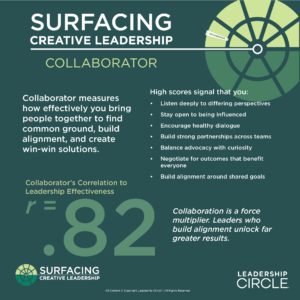
On the Leadership Circle Profile (LCP), Collaborator reflects how consistently a leader brings others into the thinking, decision-making, and ownership of outcomes. It is the capacity to genuinely engage others in the work—not just for input or alignment, but for true co-creation.
Leaders who score high in Collaborator understand that better results come from better thinking—and better thinking is almost always shared thinking.
These leaders are often experienced as inclusive, open, and engaging. They actively seek out perspectives different from their own. They create space for dialogue, even when it’s messy or inconvenient. And they know how to move a group toward clarity and action without dominating the process.
Leaders strong in Collaborator tend to:
- Invite diverse perspectives—and genuinely consider them
- Share ownership and accountability for outcomes
- Facilitate dialogue that leads to stronger decisions
- Balance advocacy with inquiry
- Build alignment without forcing agreement
This type of leadership isn’t just fun to be around, it’s a measurable advantage. Leaders who bring others into the work consistently generate stronger outcomes. Their decisions are better informed, their teams more aligned, and their execution more durable. When people have a hand in shaping the path forward, they don’t just follow through—they take ownership.
The data backs this up. Within the Leadership Circle database, Collaborator shows a correlation of r = .81 with overall effectiveness, underscoring just how central this capacity is. It reflects a fundamental truth: Leaders who effectively engage others consistently outperform those who try to carry the load alone.
When leaders strengthen this capacity, decision quality improves, execution strengthens, and commitment deepens.
🎥 Dive into the data through Data Wizardry with Joseph Leman.
Why This Dimension Matters
Leadership today is too complex to be a solo act. We often shorthand the landscape leaders face as VUCA—volatile, uncertain, complex, ambiguous—but whatever terminology we use, the experience is the same: The challenges are messy, fast-moving, and interconnected. They cut across boundaries, shift quickly, and resist simple answers. No single perspective is sufficient.
In that kind of environment, individual brilliance isn’t enough. Leadership can’t just be about having the answer—it has to be about creating the conditions for better answers to emerge. What’s required is the ability to think, decide, and act together.
Collaborator directly shapes how that happens.
At the individual level, collaboration creates engagement. When people are invited into meaningful contribution, they feel a sense of ownership. Their thinking sharpens. Their investment deepens.
At the team level, Collaborator transforms how work gets done. It creates the conditions for real dialogue—where ideas are tested, improved, and integrated. Healthy tension becomes an asset rather than something to avoid. The result is stronger decisions and more unified execution.
At the organizational level, collaboration is a multiplier. It breaks down silos, accelerates learning, and allows organizations to respond more effectively to change. When collaboration is part of the culture, organizations become more agile and innovative. When it’s not, they become fragmented, slow, and overly dependent on a few voices at the top.
In their recent conversation about Collaborator, Leadership Circle co-CEO Bill Adams and Chief Knowledge Officer Bob Anderson talk about how collaboration unlocks capability beyond one’s knowing. “I don’t naturally come by collaboration,” Bob says. But “when I started working to create the Unity Academy, I couldn’t do it alone. I needed some very, very world-class players to co-create and collaborate with me.”
🎥 Watch the full conversation with Bill and Bob.
This dimension matters most under pressure.
When stakes are high, it’s human nature to narrow—to decide faster, control more, and rely on what we already know. But this is often when collaboration is most needed. Diverse perspectives help leaders see what they might otherwise miss. Shared ownership ensures that execution doesn’t falter once decisions are made.
In short, Collaborator is essential to creating the conditions for better thinking, stronger commitment, and more effective action.
What It’s Not: Common Misconceptions
When leaders first lean into Collaborator, a few predictable concerns tend to surface.
Will this slow us down?
Will decisions get watered down?
Will I lose control of the outcome?
These questions point to some common misconceptions.
Collaborator is not about consensus decision-making. It doesn’t mean everyone gets an equal vote or that decisions take longer by default. Strong collaborators know when to open the space—and when to close it.
It’s also not about avoiding conflict. Real collaboration invites difference, tension, and disagreement. The goal isn’t harmony; it’s better thinking. That often requires staying in the discomfort longer than we’d prefer.
Nor is it about losing authority. Leaders don’t become less decisive when they collaborate well—their decisions become stronger, shaped by broader insight and supported by greater alignment.
And finally, Collaborator isn’t a personality type. It’s a leadership capacity. Whether through group dialogue or one-on-one engagement, it can be developed—and it matters regardless of leadership style.
Strip away these misconceptions, and what remains is something far more powerful than it first appears: a way of leading that consistently produces stronger outcomes by engaging the whole system.
From Reactive to Creative: The Role of Collaborator
Pressure has a way of making leaders go inward, relying on themselves instead of engaging the people around them. The internal logic is familiar: It’s faster if I just decide. I need to have the answer. Too many voices will slow this down.
In those moments, the urgency is real, clarity feels just out of reach, and stakes are high. And in the short term, it can feel more efficient. Yet over time, this inward contraction erodes perspective, weakens alignment, and burdens the leader with what was never meant to be carried alone.
A more Creative orientation shifts the equation.
Instead of closing the space, collaborative leaders expand it—intentionally bringing others into the work, especially when it would be easier not to. They trust that better thinking emerges through engagement, not isolation. And they stay open, even when the conversation becomes complex or uncomfortable.
The movement often looks like this:
- Having the answer → Staying curious
- Driving alone → Engaging others
- Holding ownership → Sharing it
Decisions become more informed. Commitment runs deeper. Execution holds.
At its best, Collaborator allows leaders to remain both in the work and in relationship—to work through tension without shutting it down or taking it over. It’s where insight sharpens, alignment builds, and momentum becomes shared.
Bill Adams connects Collaborator directly to letting go of control-based Reactive leadership. “High drive, high control says, ‘I know better. I’m right. Nobody can get the results I can.’ That doesn’t make for collaboration,” he says in his conversation with Bob Anderson on the dimension. “In order for collaboration to actually take place, I [have to] have a deep respect for you, deep respect and appreciation for what you bring and your gifts. And not only do I deeply respect it, I open in a way that you can bring your very best, so that we can bring our best together.”
🎥 Watch the full conversation with Bill and Bob.
Leveraging Collaborator: Practices + Prompts
Like all Creative Competencies, Collaborator is not something leaders either have or don’t have—it is something that can be strengthened through intentional practice.
Often, the shift begins with small, deliberate changes in how leaders engage others in everyday moments.
Ways to practice Collaborator:
- Ask before telling. Invite perspectives before offering your own.
- Stay curious longer. Resist the urge to quickly converge on a solution.
- Make space for difference. Actively seek out views that challenge your thinking.
- Share the work. Clarify where ownership can be distributed, not centralized.
- Close the loop. Ensure collaboration leads to clarity, not ambiguity.
Prompts for reflection:
- Where do I tend to over-rely on my own thinking?
- How do others experience me in moments that call for collaboration?
- What beliefs do I hold about speed, control, and inclusion?
- Where might inviting more voices actually improve the outcome?
Curious how this dimension shows up in leadership and coaching moments?
🎥 In a recent webinar, Leadership Circle coaches Jenn Bieri and Evette Stobo explored how Collaborator shapes leadership dynamics—highlighting the ways leaders either open or close the space for contribution, and what becomes possible when they choose to engage others more fully.
Recommended Reading
Want to go deeper into the practice of collaboration and collective leadership? These resources offer valuable perspectives:
- Collaborative Intelligence: Thinking With People Who Think Differently by Dawna Markova and Angie McArthur
An insightful look at how individuals think and work together, and how differences can become strengths in collaboration. - Team of Teams: New Rules of Engagement for a Complex World by General Stanley McChrystal
A powerful exploration of how shared consciousness and empowered execution enable organizations to operate with greater agility and effectiveness. - The Five Dysfunctions of a Team: A Leadership Fable by Patrick Lencioni
A practical framework for understanding the barriers to effective teamwork—and how leaders can overcome them.
Final Thoughts: “Better Together” Is More Than a Slogan
It’s easy to say we value collaboration.
It’s harder to practice it when it matters most—when time is tight, stakes are high, and having the answer feels like the job.
That’s the moment where leadership tends to contract. Where we decide faster, involve fewer, and carry more than we need to.
And it’s also the moment where Collaborator becomes essential.
When leaders stay open, invite perspective, and engage others in shaping the path forward, the outcome changes. Not just in quality, but in ownership. People don’t just follow the decision; they stand behind it.
This way of leading asks something of us. It asks patience where urgency dominates, openness where certainty is rewarded, and trust where control feels safer. It asks us to stay present even when conversations get complicated, to welcome perspectives that challenge our assumptions, and to give others room to contribute in ways we might not have anticipated.
Leaders who do this unlock more than better results—they build teams that think, act, and own the work together. The work becomes shared not just in words, but in reality. And in a world that demands more than any one person can deliver, that is exactly the kind of leadership that matters.





This article really opened my eyes to the importance of collaboration in leadership. It’s not just about working together, but truly engaging others.