
We’re diving deep into the dimensions of the Leadership Circle Profile—one at a time—to surface insights, get curious, and explore how each dimension helps leaders move from Reactive to Creative leadership. In this post, we’re unpacking Mentoring and Developing—the Creative Competency that reflects a leader’s ability to foster the growth of other people and, in doing so, scale leadership capacity across their team, organization, or community.
There’s a moment many leaders recognize—when someone on your team comes to you with a problem, and you can already see the answer.
You’ve been here before. You know what to do. It would be faster, easier, and maybe even kinder to just tell them.
And sometimes, that’s exactly what you do.
But over time, something starts to take shape. You become the go-to. The solver. The one people rely on to think things through. And while that can feel good in the short term—affirming, even—it can also become a quiet constraint. For you and for them. That dynamic benefits no one in the long term.
You see, the question a leader should be asking themselves isn’t: How do I help this person succeed right now?
It’s: How do I help them grow into the kind of leader who can succeed without me?
That’s the terrain we’re entering with Mentoring and Developing.
What Do We Mean by Mentoring and Developing?
Mentoring and Developing is the capacity to actively grow others—expanding their capability, confidence, and leadership over time—through coaching, constructive feedback, delegation, and growth-centered relationships.
It’s more than being supportive. More than being available. And more than sharing your expertise when asked.
At its best, this dimension shows up as a deliberate practice of:
- Seeing potential in others—often before they see it themselves
- Creating opportunities that stretch and grow that potential
- Offering guidance, feedback, and challenge in ways that build ownership and confidence
- Investing time and attention in long-term development, not just immediate results
Leaders strong in Mentoring and Developing don’t just solve problems; they build problem-solvers.
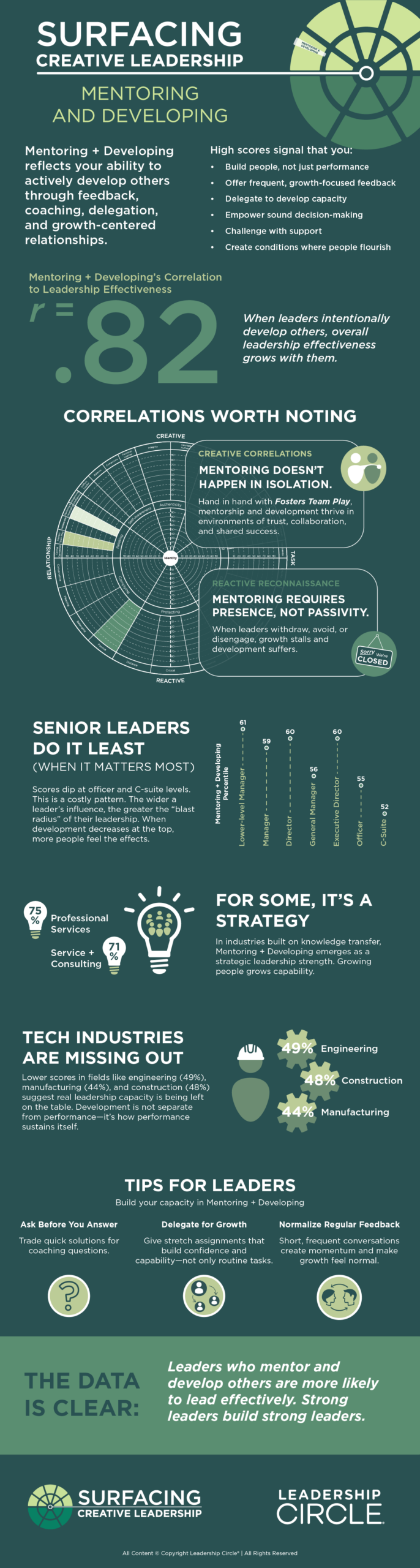
The data backs this up. Mentoring and Developing shows a strong correlation with overall leadership effectiveness (r = .82) in the Leadership Circle database. In practical terms, this means that when leaders intentionally invest in the growth of others, their effectiveness rises. Though development programs are often seen as a workplace perk, the data tells us that if you’re leading people, you should be mentoring them as much as possible. In fact, we could argue that the day-to-day job of a leader is primarily developing those around them.
🎥 Dive into the data through Data Wizardry with Joseph Leman.
Why This Dimension Matters
Organizations don’t scale through individual performance alone. They scale through leadership capacity.
When Mentoring and Developing is strong:
- Teams become more capable, independent, and resilient
- Leadership is distributed, not concentrated
- People grow into bigger roles—often faster than expected
- Engagement increases because people feel seen, challenged, and worthy of investment
When it’s underdeveloped, the costs show up quickly:
- Leaders become bottlenecks
- Teams grow dependent instead of empowered
- High-potential talent stalls—or leaves
- Problems don’t get solved, they are simply managed
When the world demands agility and shared leadership, the ability to grow others isn’t optional. It’s foundational.
Early on, leadership is often about personal capability—your expertise, your effort, your ability to deliver results. But as scope increases, effectiveness depends less on what you can do and more on what others can do because of you. This is where Mentoring and Developing becomes indispensable.
At the individual level, mentoring helps people solve their own problems, learn from experience, and build confidence. It fosters ownership and accelerates learning.
At the team level, development creates resilience. Teams where people are trusted, coached, and challenged tend to adapt faster, recover more quickly from setbacks, and take greater responsibility for outcomes.
At the organizational level, mentoring is how leadership scales. As Bob Anderson and Bill Adams note in their conversation on Mentoring and Developing, modern organizations cannot move from high-control, patriarchal structures to participatory, adaptive systems without developing leaders at every level. Capability has to be grown, not guarded.
🎥 Watch the full conversation with Bill and Bob.
What It’s Not: Common Misconceptions
Because Mentoring and Developing centers on people, it’s often misunderstood.
First, it’s not just about being supportive or nice. Support matters—but development requires more than encouragement. It needs truth. The best mentoring relationships ask us to stretch, challenge us, and include honest feedback.
Second, it’s not about seniority or having all the answers. Mentorship isn’t reserved for those with the longest tenure or highest titles. And over-relying on your own answers can limit someone else’s growth. Mentoring often means asking better questions, not giving quicker solutions.
Third, it’s not rescuing or solving problems for others. In fact, that often undermines development. Stepping in too quickly—fixing, shielding, or over-directing—can feel helpful in the moment, but it can undermine ownership and confidence over time. Effective mentors resist the impulse to take over, instead helping others think, reflect, and learn—even when it would be faster to step in.
And finally, Mentoring and Developing is not one-sided. Development only works when the person being mentored is coachable—open, humble, willing to learn. Without that reciprocity, growth stalls.
From Reactive to Creative: The Role of Mentoring and Developing
Under pressure, leaders often revert to control. They step in. They fix. They take over—driven by anxiety, perfectionism, or fear of failure. These moves may get short-term results, but they quietly erode confidence and capacity in others.
Bob Anderson offers a candid example of this dynamic in his conversation with Bill Adams, reflecting on a time when his own inability to tolerate anxiety led him to take over rather than let others learn in public. The result? People couldn’t learn from him—not because he lacked skill, but because his reactivity shut development down.
🎥 Watch the full conversation with Bill and Bob.
On the Reactive side, a few patterns often show up:
- Rescuing (high Relating): Stepping in to help, fix, or protect—sometimes at the expense of another’s growth
- Controlling (high Controlling): Directing too closely, leaving little room for autonomy or learning
- Over-reliance on expertise (high Achieving): Leading with answers instead of developing others’ thinking
These patterns usually come from a good place—a desire to help, to deliver, to ensure success. But they can inadvertently keep leadership centralized.
The shift from Reactive to Creative occurs when leaders recognize their Reactive patterns and make the conscious choice to lean into a more Creative expression of Mentoring and Developing. Doing this turns their actions from limiting to empowering:
- Instead of rescuing, give support, paired with gentle challenge
- Instead of controlling, offer guidance and space to learn
- Instead of relying on your own expertise, give constructive feedback that is clear and ask direct, developmental questions
The focus shifts from being needed to building capability.
Leveraging Mentoring and Developing: Practices + Prompts
Like any leadership capacity, Mentoring and Developing strengthens with practice. A few places to start:
Shift from answers to questions. Before offering a solution, pause and ask:
-
-
- What do you think is really going on here?
- What options have you considered?
- What would you try if you weren’t asking me?
-
Right-size your involvement. Notice when you’re stepping in.
-
-
- Am I adding clarity—or taking over?
- What would it look like to stay engaged without owning this?
-
Make development explicit. Don’t leave growth to chance.
-
-
- What is this person ready to learn next?
- Where can I stretch them in a meaningful way?
-
Offer feedback that builds, not just affirms. Go beyond encouragement.
-
-
- What’s one thing they’re doing well that they should amplify?
- What’s one growth edge that would meaningfully accelerate their development?
-
The key? Invest in the long game. In the moment, it may be slower to help someone grow and develop than it is to do the thing (whatever it is) yourself. But doing that kind of misses the point of being a leader. Building capacity in your people, strengthening their instincts and ability to think critically, and imbuing them with the confidence to take initiative is how you scale leadership over time. And ultimately, that is what drives business growth. Simply put, leaders who develop build businesses that last.
Curious how this dimension shows up in leadership and coaching moments?
🎥 In a recent webinar, Leadership Circle Principal Betsy Leatherman discussed how Mentoring and Developing shapes leadership dynamics, including common traps leaders fall into and how to overcome them.
Recommended Reading
For those interested in going deeper into the practice of developing others, these resources offer complementary perspectives:
- Multipliers: How the Best Leaders Make Everyone Smarter by Liz Wiseman and Greg McKeown
An exploration of two distinct types of leaders—“Diminishers” and “Multipliers”—and how Multipliers have an exponentially positive and profitable effect on organizations. - An Everyone Culture: Becoming a Deliberately Developmental Organizations by Robert Kegan and Lisa Laskow Lahey
A compelling look at deliberately developmental organizations. - The Coaching Habit: Say Less, Ask More & Change the Way You Lead Forever by Michael Bungay Stanier
Practical tools for shifting from advice-giving to growth-oriented conversations. - Peter Block’s work on stewardship and empowerment
A foundational lens on leadership as service rather than authority.
Final Thoughts: Be the Catalyst
At its core, Mentoring and Developing asks something subtle but profound of leaders: to shift from being the source of capability…
…to being the catalyst for it.
It’s a move from having the answers to growing the people who can find them. From leading through your own capacity to leading through the capacity of others. And in a world where leadership is increasingly shared, complex, and dynamic—that shift changes everything.
The moments that most shape us as leaders rarely feel comfortable at the time. They’re the moments when someone tells us the truth, stays connected, and believes there’s more in us than we can yet see.
That’s mentorship.
That’s development.
And ultimately, that’s how leadership scales.