We’re diving deep into the dimensions of the Leadership Circle Profile—one at a time—to surface insights, get curious, and explore how each dimension helps leaders move from Reactive to Creative leadership. In this post, we’re unpacking Driven—the Reactive Tendency that shapes how we strive, how hard we push, and how much pressure we carry along the way.
There’s a particular kind of leader we all recognize.
They’re the first one in and last one out. Their inbox is always clear. They respond quickly, produce quickly, decide quickly. When something breaks, they move to fix it. When something stalls, they push it forward. When others tire, they double down.
And we admire them for it.
Many of the organizations we work with were built on this kind of energy. Whole industries reward it. “High-performing,” “hard-charging,” “relentless”—these are compliments.
Or so we’re told.
But beneath the visible work ethic, there’s sometimes a quieter undercurrent. A subtle urgency. A belief—rarely spoken, often unconscious—that value is proven through production. That security is earned through accomplishment. That rest must be justified.
This is the terrain of Driven.
Driven is powerful. It fuels innovation, execution, and growth. It builds companies. And when it tips into overdrive, it becomes nearly invisible—especially because it often continues to produce results.
That’s what makes it so complex. And so compelling.
What Do We Mean by Driven?
In the Universal Model of Leadership, Driven reflects the degree to which a leader operates in overdrive. It is rooted in the belief that personal worth and security come from accomplishing a great deal through hard work and high performance.
At healthy levels, Driven shows up as strong work ethic, commitment, persistence, and follow-through. These leaders are reliable. They execute. They care deeply about outcomes.
At excessive levels, however, effort becomes identity. Work becomes compulsory rather than chosen. There is a subtle but persistent pressure to keep pushing—regardless of cost. Rest feels optional. Slowing down feels unsafe.
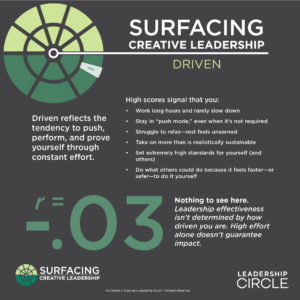
And here is the striking part: Driven has virtually no relationship to leadership effectiveness. Its correlation to leadership effectiveness is r = -.03. In practical terms, that means leadership effectiveness is not determined by how driven you are. Leaders high in Driven are no more effective, on average, than those low in Driven. High effort alone does not guarantee impact.
The data back this up. A correlation of -.03 is statistically negligible. It suggests that overdrive neither strengthens nor meaningfully improves a leader’s effectiveness. If you’re surprised, we understand. Organizations, teams, heck, even families celebrate effort. But the data doesn’t lie. You can push harder, work longer, and accomplish more volume—and still not move the needle on how effective you are perceived to be as a leader.
🎥 Dive into the data through Data Wizardry with Joseph Leman.
Why This Dimension Matters
Driven matters because it doesn’t just influence behavior—it shapes identity.
At its core, Driven becomes problematic when work stops being something we do and becomes who we are. Many leaders—often unconsciously—internalize a belief early in life: I don’t know who I am if I’m not working. That belief often has deep roots, like family expectations, cultural conditioning, or survival stories that teach us effort equals safety. Over time, productivity becomes about more than output. It becomes proof of worth.
In adulthood, this often shows up as difficulty disengaging. Leaders push harder, longer, and faster—not simply to achieve results, but because they feel they are nothing if they are not working. Pace becomes personal. Output becomes validation. And slowing down can feel not just indulgent but destabilizing, even demoralizing.
The complexity is that there is a real gift inside Driven.
Healthy drive is powerful. It carries willpower, commitment, stamina, and the ability to execute. It fuels innovation. It gets organizations off the ground. In startup environments or times of great change, this energy can be catalytic.
But as roles increase in complexity, the pattern begins to shift.
What once created advantage can begin to erode effectiveness. Overdrive narrows perspective. It amplifies control. It reduces reflection. In complex roles, where influence and systems thinking matter more than personal output—relentless push starts to backfire. After all, this level of leadership calls for relinquishing control, something a driven person often finds challenging.
Leadership Circle Co-Founders Bill Adams and Bob Anderson discussed this very tipping point in their recent conversation about the Driven dimension when they touched on Robert Kaplan’s exploration of “destructive productivity.” When short-term wins mask long-term costs, teams experience pressure, relationships deteriorate, and sustainability declines. The leader may still be producing, but the system begins to strain.
🎥 Watch the full conversation with Bill and Bob.
Perhaps more important, this deterioration isn’t dramatic. Not at first, anyway. It’s subtle. Gradual. Often invisible beneath the very results that keep reinforcing the behavior.
That’s why this dimension matters so much for leaders and coaches alike.
Driven is often admired. It’s frequently rewarded. And it can remain unquestioned precisely because it continues to produce.
But in advanced leadership roles, effectiveness depends less on how hard a leader pushes and more on how well they create space for others to think, decide, contribute, and grow.
What It’s Not: Common Misconceptions
Because Driven is so frequently rewarded, it is often misinterpreted.
Driven is not ambition.
Creative ambition is grounded in purpose. It reaches for a vision.
Driven is not excellence.
Excellence is about standards and quality. Driven is about proving value through effort.
Driven is not discipline.
Discipline supports sustainability. Overdrive erodes it.
Here’s where leaders often get it wrong: We confuse intensity with impact.
- A leader says, “I just have high standards.”
But the real question might be: If I slow down, who am I? - Another leader insists, “I thrive under pressure.”
But pause long enough and ask: Do you create the pressure required for you to thrive? - Or consider the subtle pride in exhaustion. The unspoken badge of honor in saying, “It’s been a crazy week.” The reflex to answer “Busy” when asked how things are going.
When urgency takes up residence in the atmosphere, it starts to feel normal. And when it feels normal, it becomes invisible.
We see versions of this in every industry. The hyper-competent sales closer who can’t detach. The founder who sacrifices relationships in pursuit of the next milestone. The executive who insists, “Once we hit this target, I’ll slow down.” (Spoiler alert: There is always another target.)
Need more proof that this is everywhere? Consider these popular characters from film and TV:
Logan Roy refuses to step down—not just because he’s addicted to power, but because, if he’s not running the empire, who is he?
Carmy Berzatto’s identity is entirely organized around excellence and execution. His intensity builds mastery, but it also corrodes his relationships.
Don Draper’s creative brilliance and consistent output are inseparable from his desire to outrun an unstable and unhappy personal life. When the work falters, so does he.
These examples may be fictional, but the arc is familiar: the energy that builds the empire eventually destabilizes the person building it.
Driven is misunderstood not because leaders lack drive or have too much of it, but because they rarely examine their relationship to it. Why would they? In their minds, it’s what made them successful in the first place.
Hard work is not a problem. But when hard work becomes the primary source of identity, flexibility disappears and a personal hardening takes place. Without that flexibility, leadership effectiveness suffers, and all that effort ends up for naught.
From Reactive to Creative: The Role of Driven
Driven rarely operates alone. It often rises alongside other Reactive Tendencies, such as Perfect, Pleasing, and Ambition, compounding internal and external pressure.
Perfect raises the internal bar: I have to be flawless.
Pleasing adds relational contingency: Everyone must be satisfied.
Ambition adds comparison and pace: We must outdistance the competition.
Layer Driven underneath those, and overdrive becomes the norm. The bar keeps moving. The pace escalates. Validation shifts outward. What began as commitment hardens into compulsion.
Development here is about differentiation. Separate your worth from your workload. Unhook your identity from your output. Growth becomes visible when leaders can distinguish between:
- Effort in service of purpose
- Effort in service of identity
When worth is fused with output, work feels mandatory. When worth is inherent, work becomes strategic. But this shift rarely happens in isolation. Culture and systems often reinforce the very pattern leaders are trying to outgrow.
Imagine seeing the following pop up on your team’s Slack or Teams channel: “Shoutout to Sharon for working all weekend to hit that deadline!”
Maybe no one says it directly, but the message is clear. Stay visible. Stay late. Give every last drop of effort, even if it hurts.
During his conversation with Bob Anderson about Driven, Bill Adams tells a story about his early career at Blue Cross Blue Shield, where leaders literally checked the sign-out sheet to see who left after 8 p.m. Staying late wasn’t questioned—it was admired. Working long hours became proof of commitment.
🎥 Watch the full conversation with Bill and Bob.
The pattern doesn’t always look so dramatic. Sometimes it’s quieter. A culture where meetings stack without space between them. Where declining an invitation feels political. Where no one ever models leaving early—even when the work is done.
Creative development with Driven requires a twofold shift:
- The leader loosens identification with relentless effort.
- The system begins valuing capacity over constant push.
And paradoxically, as leaders regain flexibility—when to push, when to pause—they begin to identify what is really urgent. Thus, their effectiveness strengthens. Not because they work less, but because they work with clarity. They reserve intensity for what truly matters.
Leveraging Driven: Practices + Prompts
Progress with Driven does not show up as diminished ambition. It shows up as flexibility. Range. The capacity to accelerate and decelerate without losing your identity or sense of self-worth. When a leader can sustain their intensity without living in it, the system (and their own internal world) begins to breathe again.
Ways to practice:
- Stop at 90% completion and observe the internal response.
- Design recovery into project timelines instead of adding it afterward.
- Delegate before you feel fully ready.
- Track leadership effectiveness outcomes—not activity volume—for one quarter.
Prompts for reflection:
For individuals
- What story do you tell yourself about worth and accomplishment?
- What emotions surface when you are not being productive?
- What would “enough” look like if effort were not the primary measure of value?
- Where does slowing down feel unsafe?
For teams and organizations
- What behaviors do we most visibly reward?
- Are sustainability and recovery encouraged or subtly discouraged?
- Do we celebrate volume more than impact?
- Is urgency treated as competence?
Curious how this dimension shows up in leadership and coaching moments?
🎥 In a recent webinar, Leadership Circle coaches Abigail Jones and Josh Best explored how Driven evolves from Reactive overdrive to Creative choice—unlocking performance that is both powerful and sustainable.
Recommended Reading
Want to explore more about the subtle pull of overdrive—and what it takes to separate your identity from your output? For those interested in going deeper, these resources offer powerful perspectives related to Driven:
- Beyond Ambition by Robert Kaplan
A sharp look at “destructive productivity”—when relentless drive delivers short-term wins at long-term cost—and the hidden downside of overextension. - The Spiritual Exercises by St. Ignatius of Loyola
A reflective path from control to surrender, reframing effort as alignment, service, and offering rather than relentless striving. - Drive: The Surprising Truth About What Motivates Us by Daniel H. Pink
Explores motivation beyond carrot-and-stick—autonomy, mastery, purpose—and challenges the idea that more effort equals better performance. - What Got You Here Won’t Get You There by Marshall Goldsmith
A classic exploring the idea that being driven, among other habits, creates a ceiling for impact and sharing practical strategies to deal with driven habits and improve performance.
Final Thoughts: Power Without Pressure
Driven is an extraordinary capacity. It’s an engine that moves ideas into action, visions into reality. It gets things done.
Many of us carry it with pride. It’s part of how we’ve succeeded.
And still, the data is clear. Effort alone doesn’t determine effectiveness. More output doesn’t automatically create more impact. There is a point when pushing harder begins to cost more than it creates.
Creative leadership invites a different relationship with effort, one grounded in clarity instead of compulsion.
When effort flows from clarity instead of compulsion…
When excellence grows out of purpose rather than pressure…
When striving is anchored in choice instead of fear…
Something subtle but powerful happens. Energy steadies. Capacity expands. Influence deepens.
Leaders don’t lose their edge. They lose the strain.
And from that grounded place, performance becomes more sustainable—and scalable.